Strategic Market Intelligence Future Procurement and Technology Trends in EMI & Transient Suppression
As military, aerospace, and industrial electrification accelerates, procurement directors and systems engineering leads must navigate rapidly evolving technological paradigms. Artificial Intelligence (AI) power modelling, wide-bandgap (SiC/GaN) switching components, and stringent sovereign supply chain requirements are redefining how power architectures are specified and purchased globally.
1. The Shift from Discrete Layouts to Encapsulated Modular Bricks
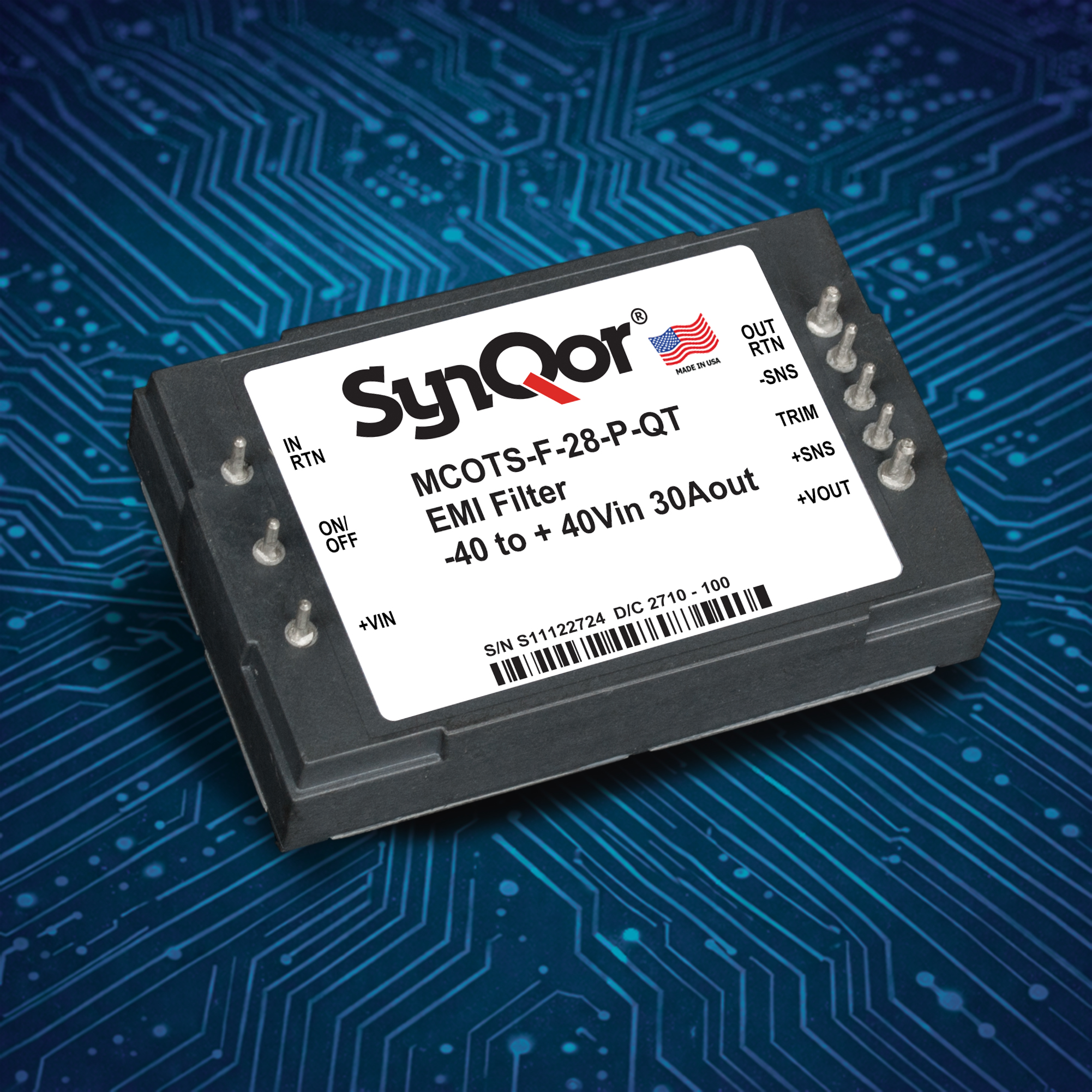
Historically, power engineers designed custom EMI filters and surge suppression networks using discrete inductors, capacitors, TVS diodes, and relay circuits. However, discrete designs suffer from four severe procurement and operational liabilities: large PCB footprints, uncharacterized parasitic layout coupling, high assembly labor costs, and unpredictable EMC qualification outcomes. Modern procurement strategies strongly favor pre-qualified, encapsulated Transient Half-Brick EMI Filters. These integrated modules deliver guaranteed, factory-tested insertion loss and transient clamping performance in a compact standard footprint, drastically compressing time-to-market and eliminating zero-day compliance failures.
2. Addressing High-Frequency EMI Challenges Born from GaN & SiC Topologies
The adoption of Wide Bandgap (WBG) semiconductors—such as Silicon Carbide (SiC) and Gallium Nitride (GaN)—in modern DC-DC converters has boosted switching speeds from hundreds of kilohertz into the multi-megahertz regime ($dI/dt$ and $dV/dt$ rates exceeding 100 V/ns). While WBG switches improve efficiency, they inject intense high-frequency conducted and radiated noise into power buses. Next-generation transient half-brick EMI filters are engineered with advanced core materials (such as nanocrystalline and high-frequency ferrite structures) that deliver flat, multi-octave attenuation spanning from 10 kHz up to 100 MHz, ensuring that ultra-fast DC-DC converters easily clear MIL-STD-461G CE102 limits.
3. Sovereign Supply Chain Security & NDAA/ITAR Compliance
Global geopolitical friction has made supply chain resilience a paramount procurement criterion. Prime defense contractors can no longer accept single-source risks, unauthorized component substitutions, or offshore manufacturing vulnerabilities. SynQor's manufacturing model—located entirely in Salem, New Hampshire, USA—provides absolute traceability, full material control under AS9100 quality management, and strict compliance with U.S. ITAR and NDAA procurement mandates. Buyers gain guaranteed product longevity with zero unplanned obsolescence.