Naval Shipboard Military Power Systems operating on surface combatant vessel
Ruggedized Naval Military Power Systems engineered for submarine environments
High efficiency military power modules for mission critical naval radar
Synchronous rectification testing for naval shipboard power conversion
MIL-STD-1399 & MIL-STD-461 COMPLIANT ARCHITECTURES

Naval Shipboard Military Power Systems: High-Efficiency Conversion, MIL-STD Compliance, and Next-Gen Maritime Engineering

Engineered to resolve unbalance, high harmonic distortion, and severe mechanical shock on naval surface vessels and submarines. Explore field-proven 3-phase UPS units, isolated PFC front-ends, Mil-COTS DC-DC modules, and EMI filters built in the USA under AS9100 quality management.

MIL-STD-1399Section 300B 3-Phase Compliance
Up to 96%Peak Efficiency via Synchronous Rectification
AS9100 / ISO-9001100% U.S. Manufacturing Traceability
MIL-S-901DGrade A Shock & Vibration Hardened
Executive Architecture Overview

Naval Shipboard Military Power Systems: Solving the Challenges of Harsh Maritime Electrical Grids

Modern naval surface combatants and submarines operate under electrical and environmental conditions far more severe than land-based military ground vehicles or commercial industrial plants. SynQor's mission-critical power architectures are custom-engineered to overcome these precise maritime challenges.

Onboard a naval vessel, electrical power is generated locally within a closed, isolated distribution network. Electrical equipment must strictly adhere to MIL-STD-1399 Section 300B, which governs 3-phase AC shipboard power interfaces (Type I 440V 60Hz, Type II 440V 400Hz, and Type III 115V 400Hz systems). Unregulated power conversion equipment introduces harmonic currents, poor power factor, line-to-line phase unbalance, and high conducted voltage spikes that compromise shipboard sonar, phased-array radars, electromagnetic launch systems, and electronic warfare suites.

Furthermore, naval combat platforms demand compliance with MIL-STD-461 (C-F) for conducted and radiated electromagnetic interference (EMI), MIL-S-901D for high-impact mechanical shock (Grade A, Class I), MIL-STD-167-1A for hull vibration, and MIL-STD-810G for ambient operating temperatures, humidity, and salt fog corrosion resistance. Standard commercial-off-the-shelf (COTS) power supplies rapidly fail or trigger platform-level non-compliance when exposed to these extreme maritime constraints.

SynQor addresses these critical requirements through its proprietary synchronous-rectifier technology, active two-stage power topologies, and fully encapsulated Mil-COTS module architectures. Designed and manufactured entirely in Salem, New Hampshire, USA, SynQor's Naval Shipboard Military Power Systems deliver industry-leading conversion efficiency up to 96%, enabling fanless, sealed IP67/NEMA enclosure integration while extending operational mean time between failures (MTBF).


Military shipboard radar and defense electronics powered by SynQor power systems
Recommended Naval Product Architecture

From individual board-mounted Mil-COTS power modules to complete 1U rack-mount uninterruptible power systems (UPS), SynQor delivers qualified, low-dissipation power topologies for defense maritime procurement.

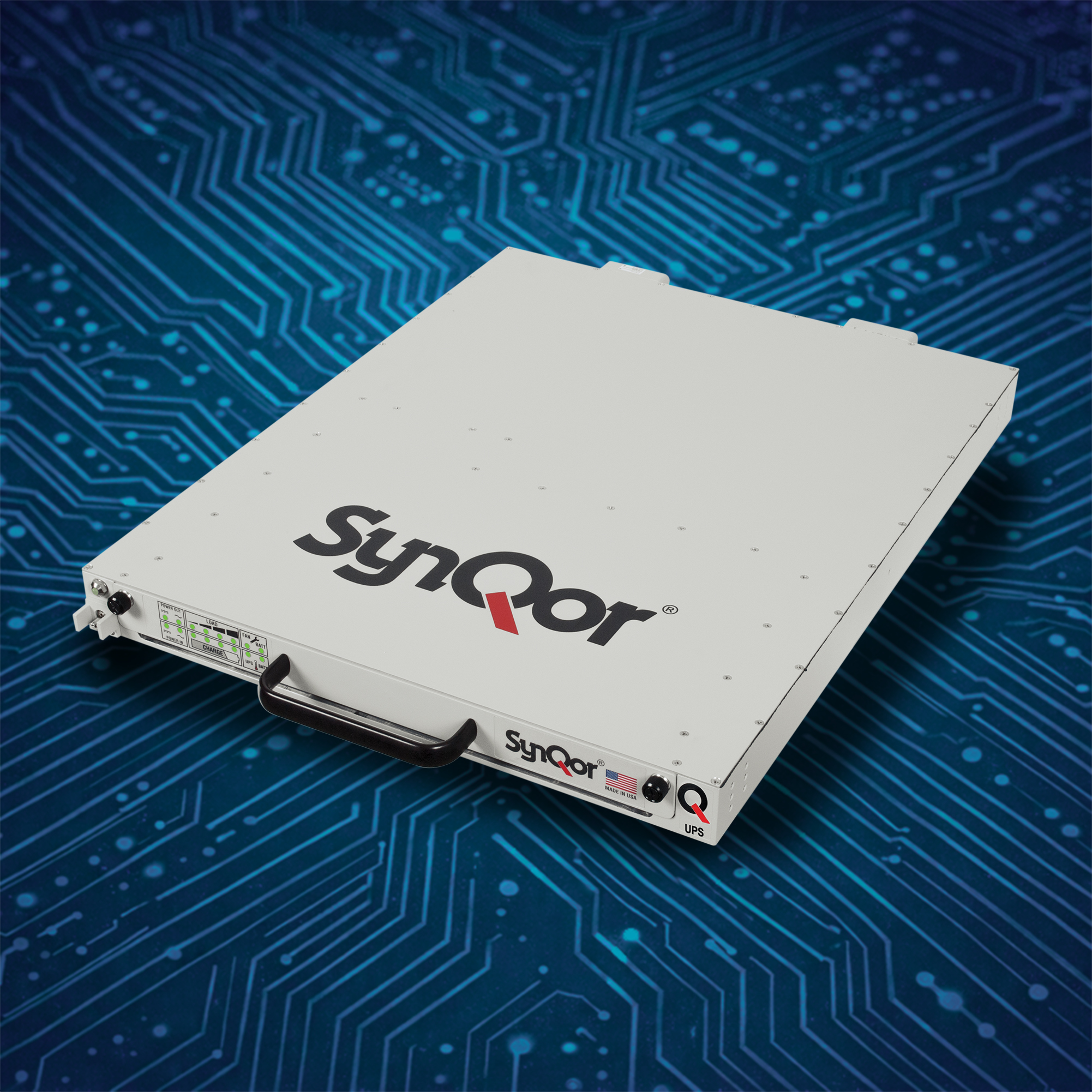
Naval 3-Phase Field-Grade UPS

1U & 2U rack-mount uninterruptible power systems designed for MIL-STD-1399 3-phase 115Vrms line-to-line inputs. Solves unbalanced phase load problems on submarines and frigates while providing clean battery backup.

Inquire About Naval UPS
SynQor Military Field-Grade 3-Phase Uninterruptible Power Supply for Naval Vessels

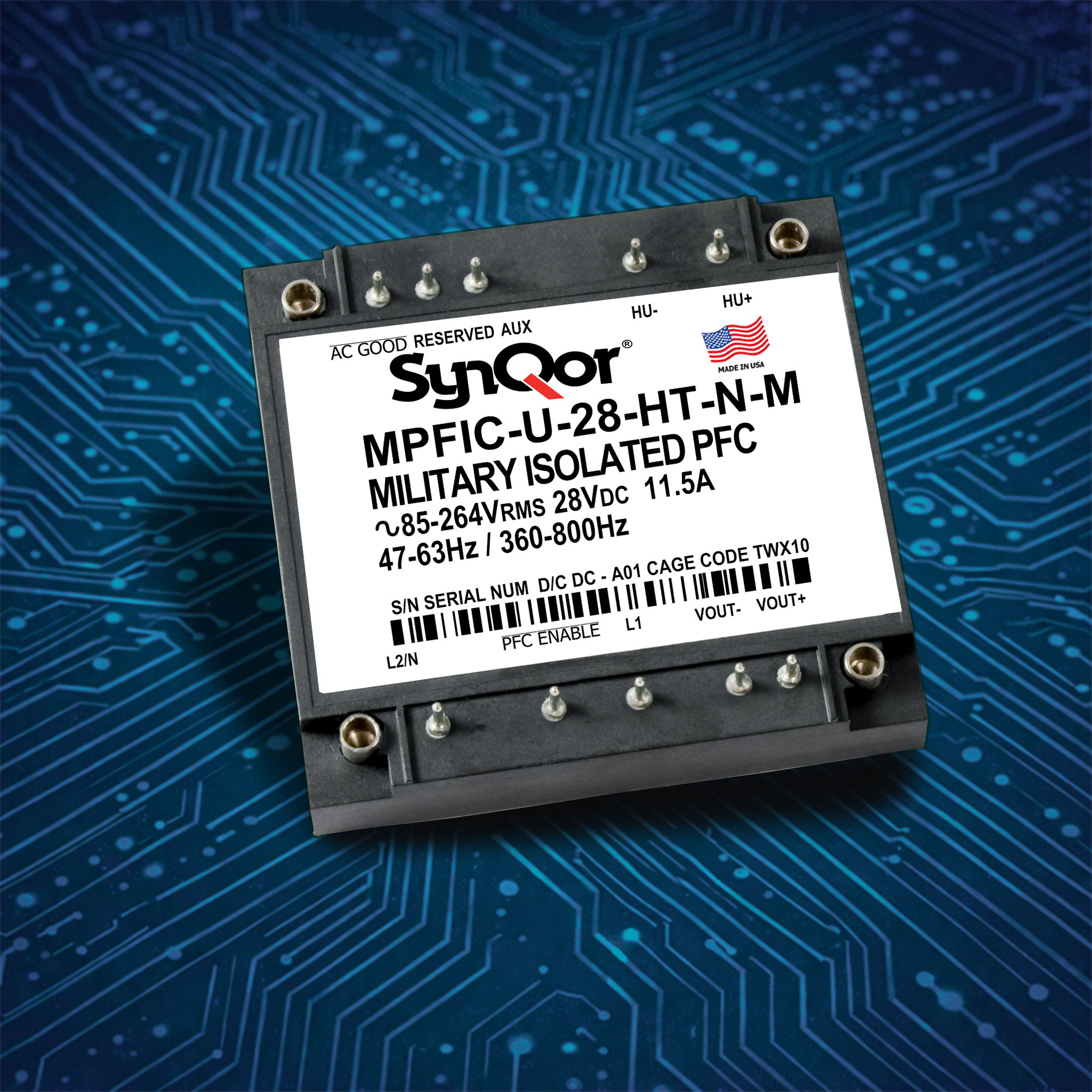
3-Phase MPFIC PFC Modules

Isolated 3-phase Power Factor Correction front-end modules (MPFIC-115-3PD) compliant with MIL-STD-704 and MIL-STD-1399, delivering high power factor (>0.99) and low THD (<3%).

Inquire About PFC Modules
SynQor isolated 3-phase power factor correction module for shipboard systems

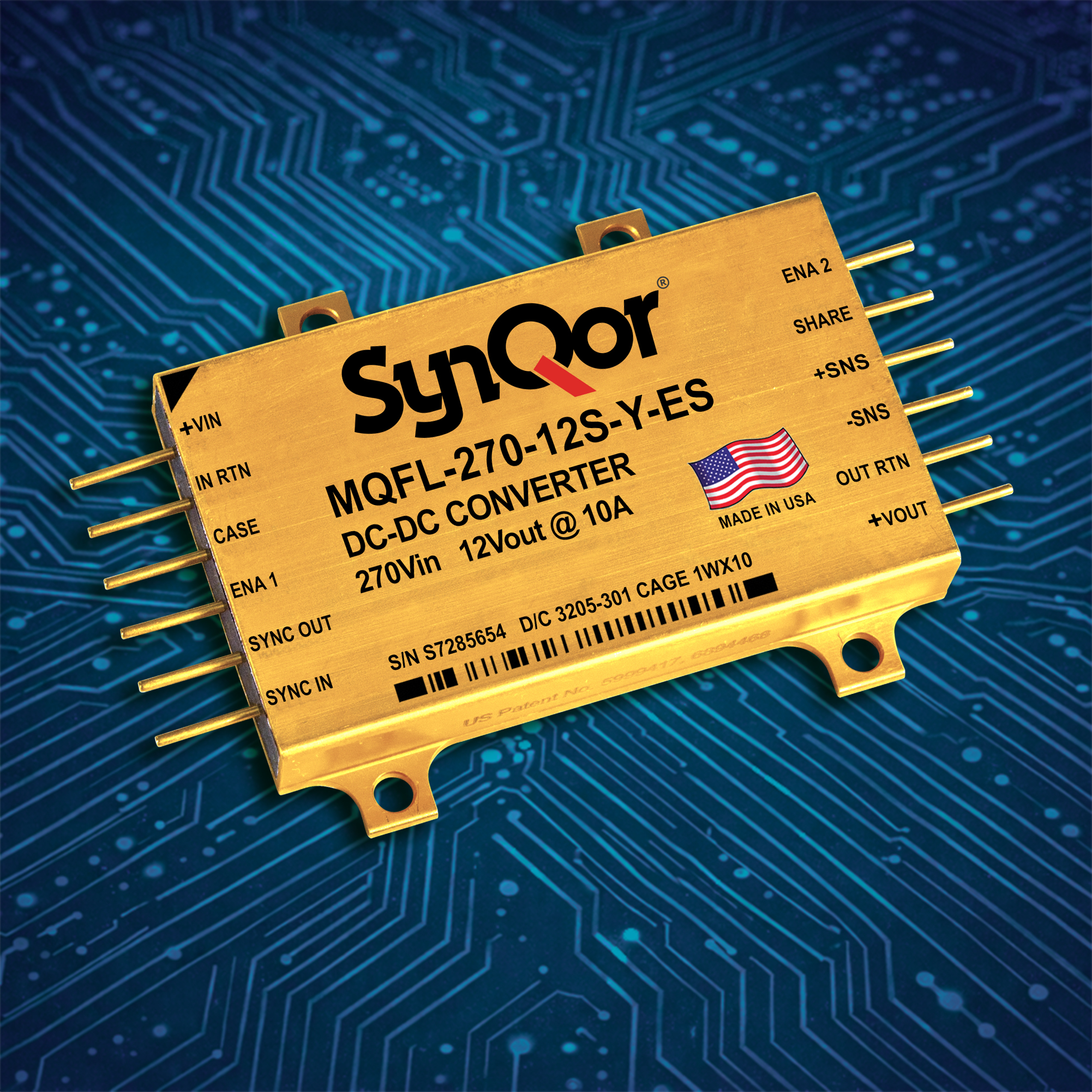
MilQor® Isolated DC-DC Bricks

High-reliability half-brick and full-brick DC-DC converters featuring wide input voltage ranges, 2500V isolation, and synchronous rectification for high-density naval payloads.

Inquire About DC-DC Converters
SynQor Hi-Rel isolated DC-DC converter brick for naval defense systems

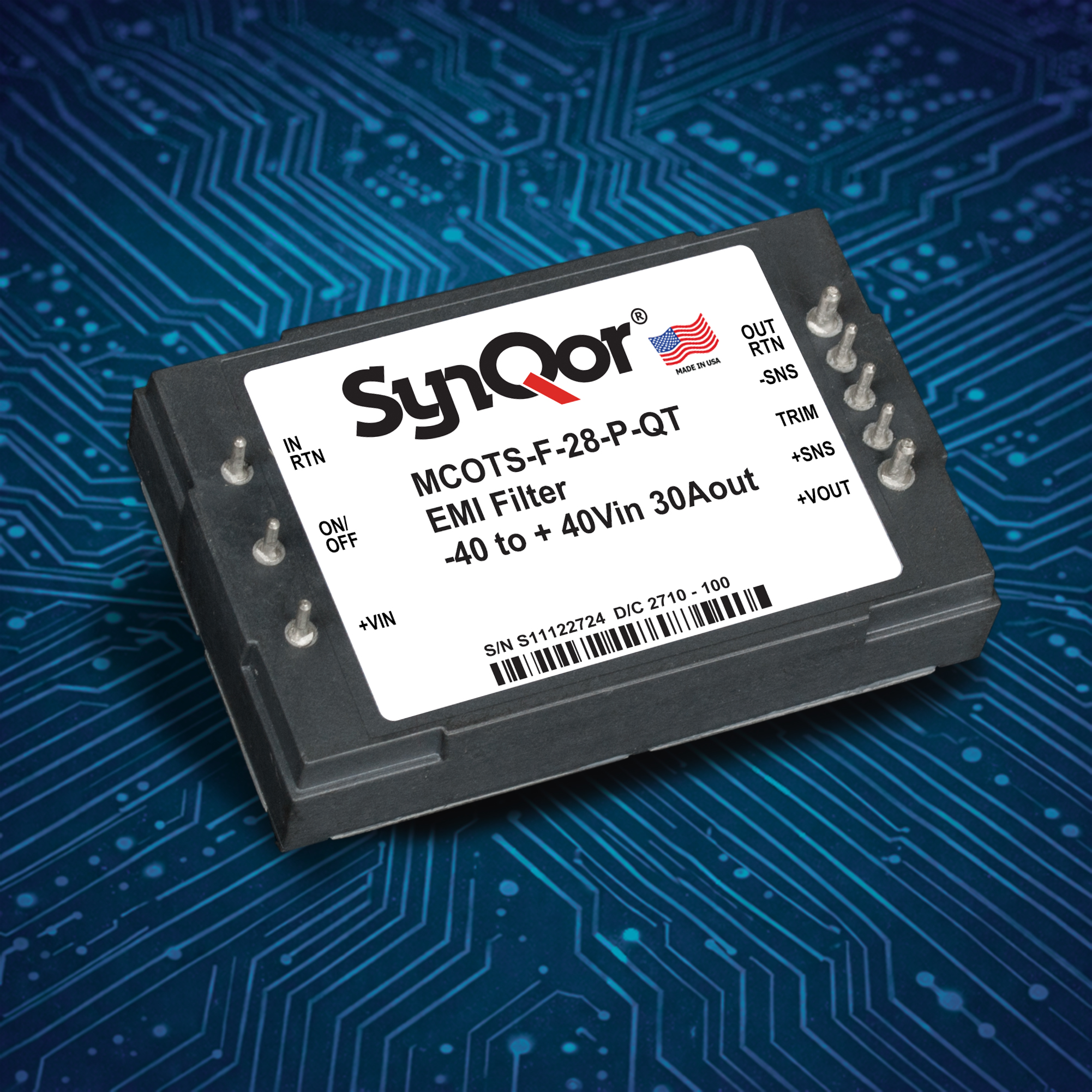
MCOTS Transient EMI Filters

Half-brick and full-brick line filters designed to bring power module chains into 100% compliance with MIL-STD-461 (CE101/CE102) and MIL-STD-1275/MIL-STD-704 transients.

Inquire About EMI Filters
SynQor MCOTS transient EMI filter module for defense applications
Technology Analysis & R&D Roadmap

Naval power design is undergoing a structural shift driven by higher energy requirements, electrification of propulsion and weaponry, and strict thermal limits inside sealed hull compartments.

01 — TOPOLOGY

Synchronous Rectification & Wide Bandgap Semiconductors

Traditional diode-based rectifiers create significant forward conduction losses ($V_f \times I$), generating excessive heat in enclosed military shipboard compartments. SynQor pioneered the commercialization of synchronous rectification, replacing lossy Schottky diodes with actively controlled low-$R_{ds(on)}$ MOSFETs. Modern naval power architectures are further integrating Silicon Carbide (SiC) and Gallium Nitride (GaN) switching stages, allowing operating frequencies above 500 kHz, reducing magnetic component size by 40%, and maintaining efficiencies above 95% across broad load profiles.

02 — THERMAL DENSITY

Conduction Cooling for Fanless Sealed Enclosures

Forced-air cooling using mechanical fans introduces single points of failure, draws in corrosive salt fog, and degrades acoustic stealth on naval vessels and submarines. Next-generation shipboard power systems utilize full potted baseplate conduction cooling. By transferring heat directly through metallic baseplates into liquid-cooled cold plates or hull-mounted heatsinks, power density is maximized while achieving IP67 / NEMA 4X environmental isolation without rotating fans.

03 — HARMONIC CONTROL

Active 3-Phase Power Factor Correction (PFC)

As naval surface combatants install high-power radar suites and mission systems, nonlinear electrical loads generate destructive harmonic distortion on the ship's 440V/115V AC bus. Next-generation naval power designs require active 3-phase PFC topologies that suppress total harmonic distortion (THD) below 3% and achieve power factors of 0.99. This ensures compliance with MIL-STD-1399 Section 300B, prevents transformer overheating, and preserves power quality for sensitive combat sensors.

Global Defense Procurement Strategy

Global defense prime contractors and naval procurement authorities (including NAVSEA, Royal Navy, and NATO allied navies) are fundamentally changing how power conversion systems are specified and sourced for next-generation surface combatants and submarines.

  • Transition to Integrated Power Systems (IPS) & All-Electric Ships (AES): Future naval platforms consolidate propulsion, sensor suites, and ship services onto a unified medium-voltage DC or AC power backbone. Power conversion systems must dynamically step down high bus voltages while maintaining galvanic isolation and transient immunity.
  • Modular Open Systems Approach (MOSA): Defense programs mandate standard form-factor building blocks (such as half-brick and full-brick Mil-COTS modules) to accelerate upgrade cycles, simplify field repairability, and avoid single-vendor lock-in.
  • Directed Energy & High-Peak Pulsed Load Support: Laser defense systems, railguns, and active electronically scanned array (AESA) radars impose severe pulsed power demands on the shipboard grid. Power systems must provide rapid transient response and energy buffer integration to prevent bus voltage collapse.
  • Anti-Obsolescence & Supply Chain Sovereignty: Procurement officers prioritize suppliers with onshore manufacturing, full AS9100 quality control, and guaranteed multi-decade product support to eliminate risks associated with offshore component shortages.
Request Procurement Datasheets
Future naval platform featuring integrated power systems and ruggedized power modules
E-E-A-T & Enterprise Strengths

Why Leading Defense Prime Contractors Choose SynQor

SynQor’s process-centered organization and U.S. manufacturing facility enforce strict hardware discipline from initial circuit topology design through qualification testing and high-volume production.

Send an Inquiry

Exceeding ISO-9001 and AS9100 Quality Requirements

Every naval power supply module and 3-phase UPS system undergoes 100% full-load environmental stress screening (ESS), thermal cycling, and automated electrical testing. Complete component traceability stands up to NAVSEA and prime-contractor audits.

100% Designed & Manufactured in Salem, New Hampshire, USA

Engineering, qualification testing, planar magnetics fabrication, and surface-mount manufacturing are performed under one roof in our state-of-the-art U.S. facility, protecting defense programs from foreign supply chain disruptions.

25+ Years of Pioneer Synchronous Rectifier Leadership

Founded by MIT faculty and industry experts, SynQor holds foundational patents in high-efficiency DC-DC conversion. Our legacy of field-proven performance spans thousands of deployed military shipboard, ground, and airborne units.

Purchasing & Engineering FAQ

Naval Shipboard Military Power Systems: Frequently Asked Questions

Comprehensive engineering and procurement answers addressing real-world queries asked by naval system architects and defense buyers.

MIL-STD-1399 Section 300B establishes interface requirements for shipboard AC power utilization equipment on naval surface ships and submarines. Key parameters include tight limits on phase current unbalance, input line harmonics, power factor, and inrush current transients. SynQor's naval power systems incorporate active 3-phase power factor correction (MPFIC) modules designed specifically for 115Vrms and 440Vrms line-to-line inputs. By maintaining a near-unity power factor (>0.99) and suppressing total harmonic distortion (THD) below 3%, SynQor units eliminate phase unbalance issues, prevent neutral conductor overheating, and safeguard sensitive combat communications and sonar systems connected to the same AC bus.

Traditional secondary-side rectifiers use Schottky or silicon diodes, which suffer from a fixed forward voltage drop ($V_f \approx 0.5\text{V}$ to $1.0\text{V}$). At high output currents (e.g., 100A), diode conduction losses equal 50W to 100W of wasted energy as heat. SynQor pioneered synchronous rectification by replacing output diodes with actively controlled, ultra-low $R_{ds(on)}$ MOSFETs. Conduction losses drop by up to 60-80%, increasing module efficiency up to 95-96%. This drastic reduction in power dissipation lowers baseplate operational temperatures, shrinks heatsink volume, eliminates mechanical cooling fans, and significantly increases system mean time between failures (MTBF) inside sealed naval electronics bays.

Naval combat vessels experience high-impact mechanical shock from explosive ordnance (underwater explosions) and severe structural vibration from heavy propulsion machinery. SynQor Mil-COTS power modules and rack-mount UPS units are constructed with rugged aluminum chassis baseplates, heavy-gauge copper planar transformers, and full silicone or epoxy potting encapsulation. All internal components are mechanically anchored to withstand MIL-S-901D Grade A, Class I, Type A high-impact shock testing without electrical interruption or physical displacement. Additionally, compliance with MIL-STD-167-1A Type I environmental vibration ensures continuous long-term operation under low-frequency shipboard vibrations.

Naval electronic equipment must comply with MIL-STD-461 (CE101, CE102, CS101, CS114, CS115, CS116) for electromagnetic interference and susceptibility. SynQor designs custom-matched transient EMI line filters (such as the MCOTS-F series) that work seamlessly with our isolated DC-DC and AC-DC modules. The filter modules incorporate differential-mode and common-mode passive LC networks combined with high-voltage clamping TVS diodes. This pre-engineered chain suppresses severe input voltage transients up to 210V for 100ms while keeping conducted emissions well below MIL-STD-461 limit curves, saving program engineers months of iterative EMC lab tuning.

Yes. Due to high efficiency (up to 96%) achieved via synchronous rectification and two-stage power topologies, thermal dissipation is minimized. SynQor military modules and field-grade UPS units are specifically engineered for baseplate conduction cooling. Thermal energy is conducted directly from internal semiconductor junctions through a thermal interface pad to an external cold plate, liquid-chilled chassis, or aluminum enclosure wall. This allows complete enclosure sealing against ambient humidity, salt fog, dust, and water ingress (IP67 / NEMA 4X compliance) without requiring air filters or cooling fan maintenance.

Naval surface ships and submarines have operational lifespans of 30 to 50 years. Commercial component cycles, however, change rapidly every 3 to 5 years. SynQor protects defense prime contractors by offering extended product lifecycles, strict baseline revision control, and form-fit-function replacement guarantees. Because all design, planar transformer winding, assembly, and automated testing are conducted in-house at our AS9100-certified facility in Salem, New Hampshire, USA, SynQor maintains complete oversight of component supply chains and retains full engineering capability to support programs across multi-decade lifecycles.

SynQor's military field-grade UPS family (such as the UPS-1500 and UPS-3000 series) accepts 3-phase AC inputs (115Vrms line-to-line, 47-63Hz or 400Hz) complying with MIL-STD-1399 Section 300B, as well as wide DC input voltages. Outputs include clean, regulated single-phase AC (115V or 230Vrms) and isolated DC outputs (28Vdc, 270Vdc, or custom voltages). The units integrate user-replaceable lithium-iron-phosphate (LFP) or sealed lead-acid battery packs, providing seamless battery backup runtime during shipboard power outages while maintaining a compact 1U or 2U rack form factor.

Have a Naval Shipboard Power Architecture to Qualify?

Send our senior naval application engineers your input voltage range, phase requirements, load profile, thermal baseplate limits, and MIL-STD target list for a complimentary architectural review.

Send an Inquiry Contact Engineering Team