
MilQor® Hi-Rel DC-DC Modules
High-reliability isolated converters featuring fixed-frequency switching, full encap housing, and 28V, 270V, or 48V input options for critical mission payloads.
Explore MilQor® Series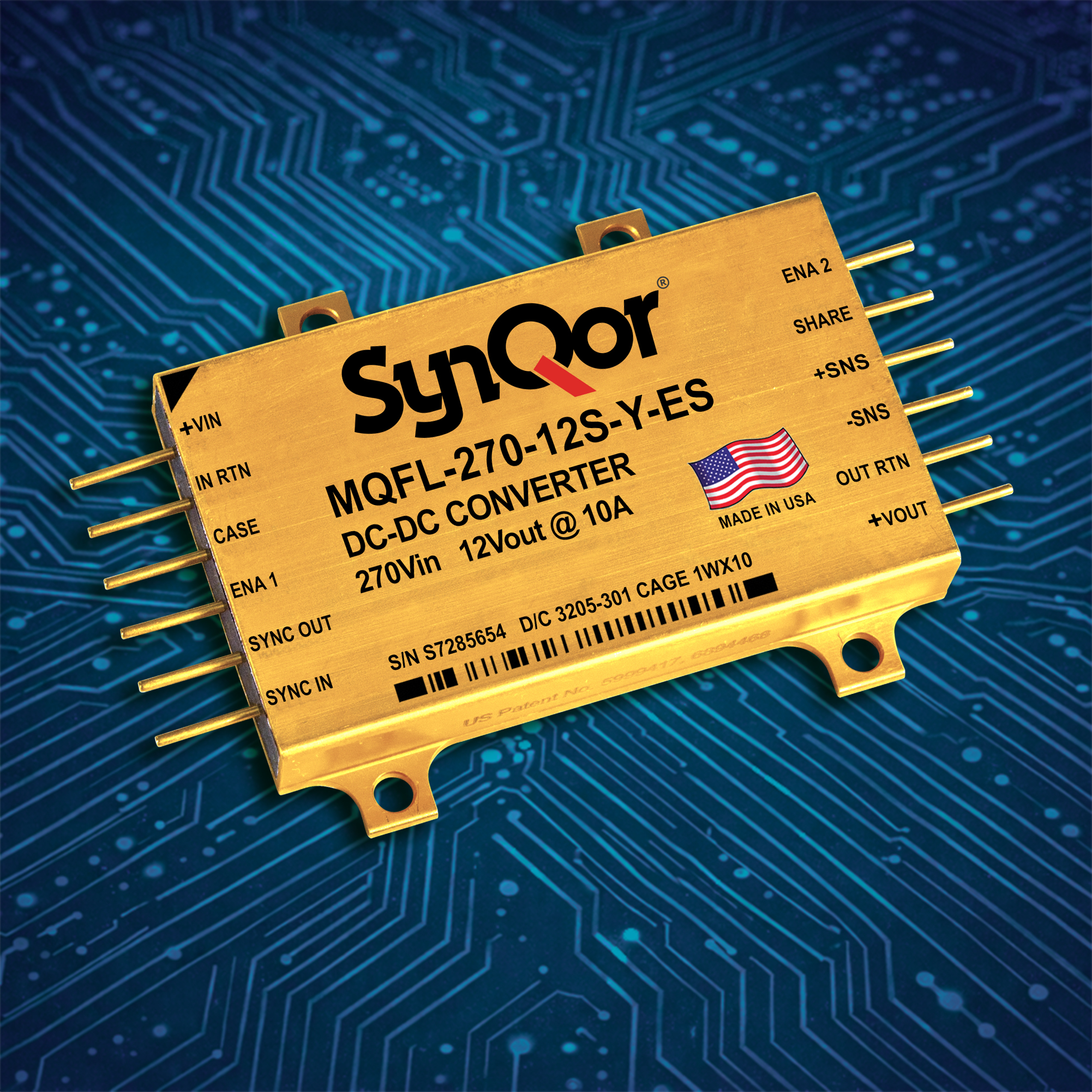




Engineered and manufactured exclusively in the USA under AS9100 and ISO-9001 certifications. Delivering up to 96% efficiency, broad continuous input ranges, and field-proven reliability under MIL-STD-704, MIL-STD-461, MIL-STD-1275, and RTCA DO-160 standards.
Modern defense systems—spanning ground combat vehicles, tactical airborne radars, naval surface combatants, and uncrewed autonomous platforms—demand ruggedized power conversion modules that deliver flawless reliability under intense electrical noise, severe thermal extremes, and high shock environments.
In high-reliability (Hi-Rel) military electronics, power conversion is rarely a straightforward task of stepping down a supply voltage. Military platforms present some of the most challenging operating environments in power electronics engineering. Input voltage lines fluctuate wildly due to generator surges, load dumps, and inductive switching spikes. Meanwhile, payload densities in modern defense applications continue to escalate, shrinking available PCB real estate while raising thermal dissipation requirements.
For decades, traditional military DC-DC converters relied on single-stage topologies utilizing Schottky diode rectification. While mechanically simple, diode-based rectification inherently caps conversion efficiency at 80% to 85% due to the fixed forward voltage drop ($V_f$) across the diodes. At high output currents, this forward voltage translates into substantial heat generation ($P_{loss} = I_{out} \times V_f$). In sealed, conduction-cooled defense enclosures without active cooling fans, this excessive thermal loss forces severe operational derating, compromises MTBF (Mean Time Between Failures), and forces system designers to increase heat sink mass—violating strict Size, Weight, Power, and Cost (SWaP-C) constraints.
SynQor pioneered the commercial and defense implementation of high-frequency synchronous rectification inside isolated DC-DC converters. By replacing lossy passive diodes with actively driven, ultra-low $R_{DS(on)}$ MOSFETs and coupling them with a proprietary two-stage power architecture, internal conduction losses drop exponentially. This breakthrough drives module efficiency up to 95%–96%, reducing power dissipation by more than 50% compared to legacy military converters.
The technical advantage of a two-stage topology is twofold: the first stage handles wide-range input voltage regulation and transient suppression, while the second stage optimizes isolation and high-efficiency voltage reduction. This decoupling prevents efficiency collapse at wide input extremes (such as continuous 16–40 V continuous input with 50 V or 100 V transient immunity). Lower internal thermal dissipation directly lowers junction temperatures ($T_j$), allowing SynQor Hi-Rel Military DC-DC converters to deliver 100% full rated power at baseplate temperatures up to +100°C without requiring forced airflow.
Examine SynQor’s field-proven defense power modules designed for mission-critical reliability across land, air, and sea platforms.
High-reliability isolated converters featuring fixed-frequency switching, full encap housing, and 28V, 270V, or 48V input options for critical mission payloads.
Explore MilQor® SeriesCompanion half-brick and full-brick filter modules providing full compliance with MIL-STD-461 (CE101/CE102) and MIL-STD-1275 surge suppression.
Explore EMI Filters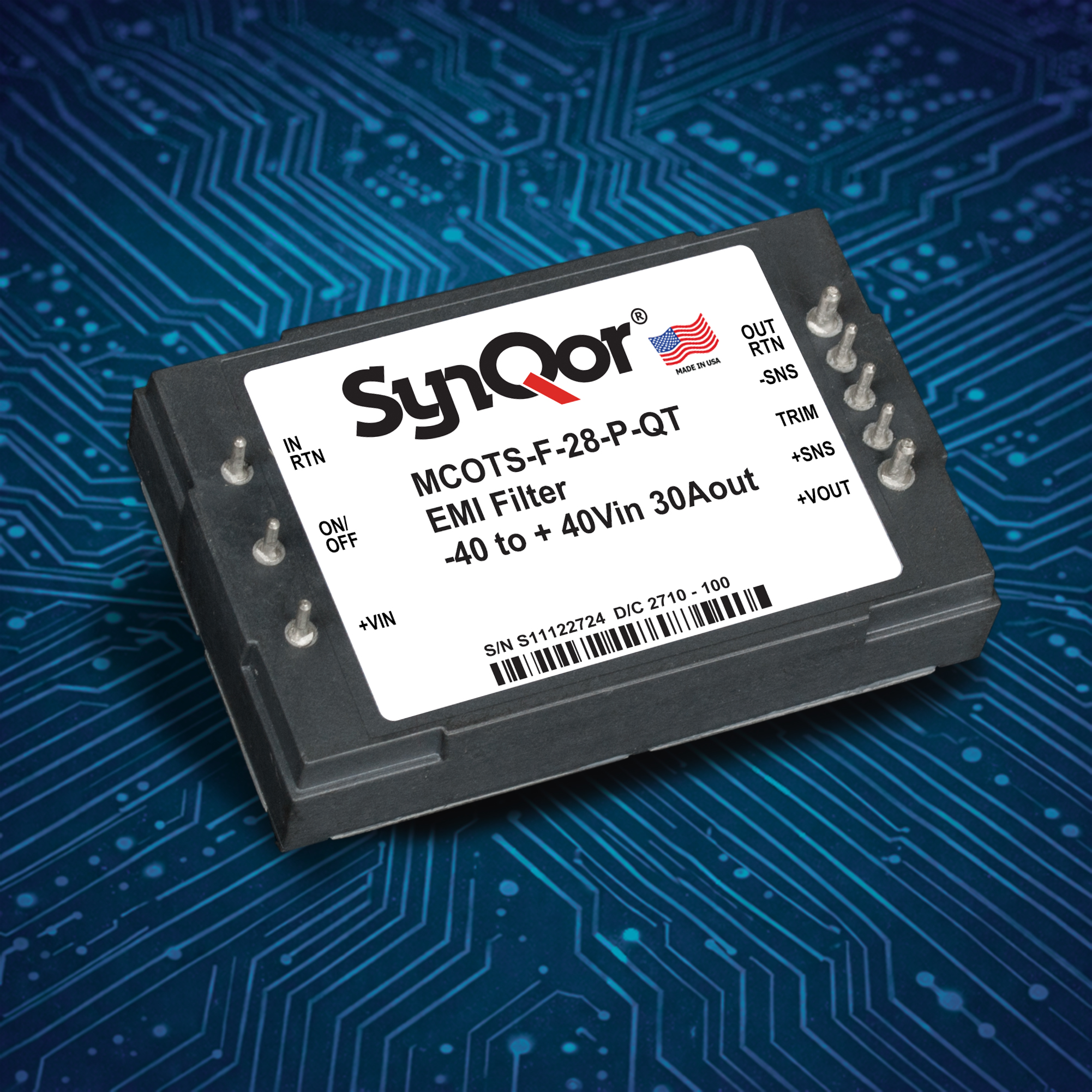
Isolated 3-phase power factor correction front-end modules tailored for military aircraft and shipboard power distribution architectures.
Explore 3-Phase PFC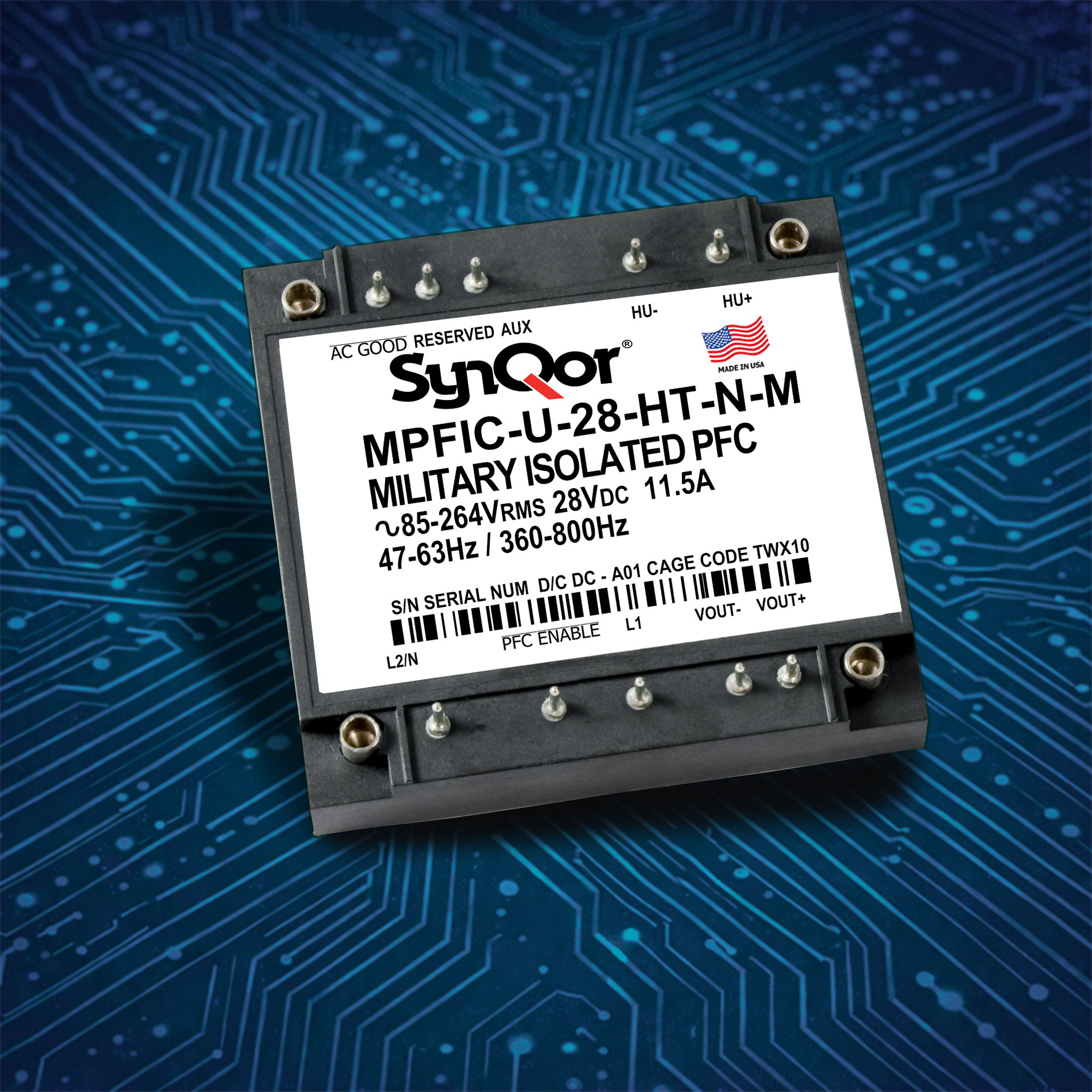
Ultra-rugged 1U rackmount UPS systems engineered to withstand severe naval vibration, wide ambient temperatures, and unbalanced 3-phase loads.
Explore Military UPS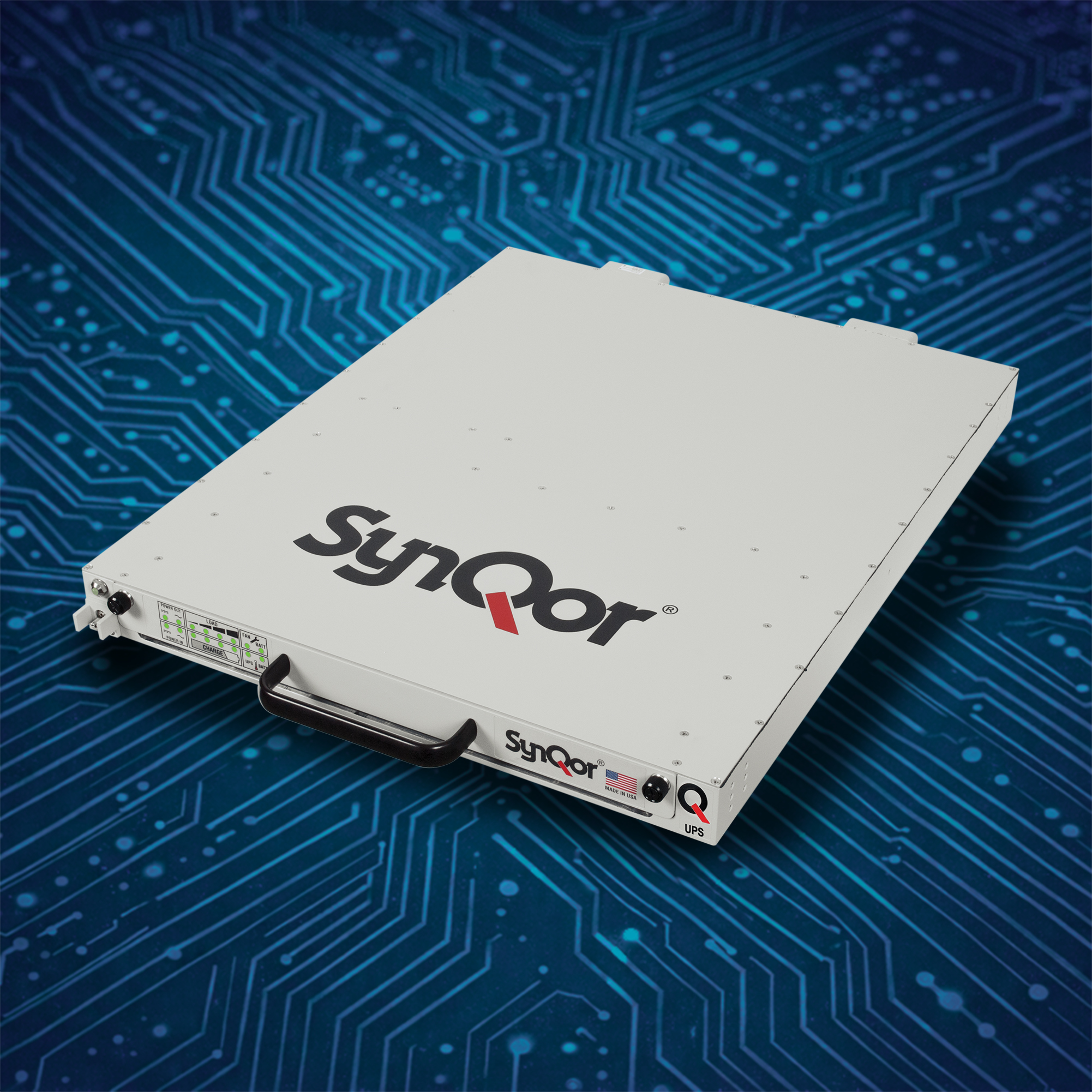
Selecting the proper Hi-Rel military DC-DC converter requires evaluating continuous input voltage ranges, transient handling capabilities, and compliance with military standard envelopes.
| Product Family | Input Voltage Range | Output Power / Voltage | Efficiency (Peak) | Military Compliance Standards | Key Application Focus |
|---|---|---|---|---|---|
| MilQor® MCOTS-28 | 16 - 40 V continuous (50 V for 100 ms) | 50 W - 600 W (1.8 V to 50 V DC) | 95% | MIL-STD-704(A-F) MIL-STD-1275D/E | Military Ground Vehicles, Tactical Radios, Command Posts |
| MilQor® MCOTS-270 | 155 - 400 V continuous (475 V for 100 ms) | 100 W - 800 W (3.3 V to 48 V DC) | 96% | MIL-STD-704(A-F) RTCA/DO-160G | Airborne Radar, Avionics Bays, High-Voltage UAV Busses |
| MilQor® MCOTS-48 | 34 - 75 V continuous (100 V for 100 ms) | 50 W - 500 W (1.8 V to 48 V DC) | 95% | MIL-STD-461(C-F) Def Stan 61-5 | Naval Shipboard Communications & Submarine Systems |
| MilQor® MPFIC 3-Phase | 85 - 264 Vrms AC / 3-Phase (360 - 800 Hz) | 1.5 kW - 3.0 kW (28 V or 48 V DC output) | 94% | MIL-STD-1399 MIL-STD-704F | Naval Shipboard Central Power, Aircraft Ground Support |
| MCOTS-F EMI Filter | 0 - 40 V continuous (±500 V surge) | Up to 30 A / 50 A continuous | 99% | MIL-STD-461(CE101/102) MIL-STD-1275(Surge/Spike) | Single-source filter chain for all MilQor® 28V converters |
Procurement officers and defense system architects are fundamentally changing how power modules are specified, sourced, and maintained across multi-decade defense programs.
Historically, prime defense contractors relied on custom-designed power supplies built to unique military blueprints. However, custom power development incurs exorbitant non-recurring engineering (NRE) fees, introduces multi-year qualification delays, and leaves programs vulnerable to component obsolescence. Modern defense procurement heavily favors Mil-COTS (Military Commercial-Off-The-Shelf) modules. Mil-COTS DC-DC converters offer pre-qualified compliance with MIL-STD-704, MIL-STD-461, and MIL-STD-1275 inside standardized brick footprints, eliminating NRE costs and compressing time-to-deployment from years to weeks.
With geopolitical tensions escalating global supply chain vulnerabilities, prime contractors require 100% supply chain transparency. Microelectronic counterfeiting and unrecorded component substitutions present severe operational risks to defense platforms. SynQor eliminates this risk by manufacturing all products inside its single, state-of-the-art facility in Salem, New Hampshire, USA. Operating under AS9100D aerospace quality management, SynQor maintains full lot-level component traceability, rigorous wafer-to-assembly quality controls, and comprehensive Environmental Stress Screening (ESS), including burn-in and temperature cycling on 100% of military-grade units.
Defense platforms—such as naval destroyers, armored fighting vehicles, and fighter jets—frequently remain in active service for 20 to 40 years. Standard commercial semiconductor lifecycles (typically 3 to 5 years) are completely incompatible with defense lifecycles. SynQor guarantees long-term product support by controlling its designs, maintaining extensive component archives, and offering Form-Fit-Function drop-in replacements for legacy brick modules, protecting programs from forced PCB re-layouts.
As modern military platforms integrate high-power digital payloads—including AI mission computers, active electronically scanned array (AESA) radars, and high-energy laser systems—the demands placed on power conversion continue to evolve.
Gallium Nitride (GaN) and Silicon Carbide (SiC) switches enable elevated switching frequencies above 1 MHz. Higher frequency switching drastically reduces magnetic component volume (transformers and inductors), unlocking unprecedented power density inside micro-quarter-brick footprints while reducing thermal resistance.
Modern military aircraft (such as the F-35 and next-gen stealth bombers) are migrating from 28V DC or 115V AC power buses toward 270V DC architectures. High-voltage distribution reduces current draw, allowing thinner, lighter wiring harnesses that reduce overall aircraft weight while boosting payload capacity.
Future power module architectures are embedding active transient clamp circuits directly into the converter brick substrate. This eliminates the need for large, external passive filter capacitors, achieving true single-chip compliance with MIL-STD-1275 heavy surge profiles.
Explore how SynQor Hi-Rel military DC-DC converters power critical systems across aerospace, naval, land, and harsh industrial environments.
Military ground vehicles endure heavy engine starting surges, inductive load spikes, and ambient temperature swings. SynQor’s MilQor® 28V input converters—when combined with MCOTS EMI filters—withstand severe 100V transients and severe reverse polarity conditions under MIL-STD-1275D/E.

AeroQor® and MilQor® airborne power modules are engineered specifically for altitude thermal management and lightning transient immunity under RTCA DO-160G and MIL-STD-704(A-F). Featuring light weight, high power density, and controlled input current inrush.

Naval power distribution systems encounter phase imbalances, harmonic distortion, and severe mechanical vibration. SynQor’s naval power units address MIL-STD-1399 (Section 300) power quality requirements and MIL-STD-810G shock and vibration tests.
RailQor® DC-DC modules deliver isolated DC power to rolling stock electronics under EN 50155. Engineered to handle catenary power spikes, wide input swings (24V to 110V continuous), and extreme shock environments.

Rugged industrial DC-DC converters optimized for motion control, autonomous robotics, remote communications, and harsh outdoor environments where fanless reliability is non-negotiable.

High power density medical power modules meeting EN 60601-1 and IEC 60601-1-2 4th Edition. Designed with ultra-low earth leakage currents and 2xMOPP isolation for surgical and diagnostic systems.

SynQor’s process-centered organization maintains total control over design, qualification, and production at our U.S. headquarters—guaranteeing that every shipping module matches the exact qualification profile of the original prototype.
Rigorous, audited quality management systems ensuring complete lot traceability, strict design controls, and documented compliance for defense prime audits.
Domestic U.S. manufacturing guarantees compliance with defense procurement regulations, eliminates foreign supply risks, and safeguards critical IP.
Over 25 years of continuous power conversion innovation, setting global industry standards for efficiency, power density, and thermal endurance.
In-depth technical answers addressing critical engineering, compliance, and procurement queries from defense systems architects.
Hi-Rel (High-Reliability) Military DC-DC Converters are engineered to operate continuously under severe environmental, electrical, and mechanical stresses that would destroy standard commercial modules. Key design distinctions include: 1) Extended operating temperature baseplates ranging from -55°C to +100°C; 2) Ruggedized construction utilizing full-encapsulation potting to withstand high MIL-STD-810G shock and vibration profiles; 3) Conservative component derating adhering strictly to NAVAIR/MIL-HDBK-217F guidelines; and 4) Input stage architecture designed to withstand continuous bus voltage anomalies and high-energy surge pulses as defined by MIL-STD-704 and MIL-STD-1275.
Furthermore, SynQor Hi-Rel military modules undergo 100% environmental stress screening (ESS), including temperature cycling and full-load burn-in testing prior to shipment, ensuring zero-defect delivery for mission-critical payloads.
Compliance is achieved through a coordinated pairing of converter topologies and matching EMI/transient filter modules: MIL-STD-704 (A-F) compliance is built directly into the converter's input stage, which accommodates wide continuous operating ranges (e.g., 16-40V for 28V systems, 155-400V for 270V systems) and short-term voltage transients (50V for 100ms or 475V for 100ms). MIL-STD-1275D/E compliance for ground vehicle 28V systems—requiring survival against +100V 50ms surges and 250V spikes—is guaranteed when pairing SynQor MilQor® DC-DC converters with SynQor MCOTS transient filter modules. MIL-STD-461 (CE101, CE102, CS101, CS114, CS115, CS116) conducted emission and susceptibility compliance is verified and documented for the combined filter-plus-converter chain, sparing system designers the risk of designing complex discrete EMI filter networks.
Synchronous rectification replaces traditional lossy Schottky diodes on the secondary output stage with actively driven, ultra-low $R_{DS(on)}$ MOSFETs. In traditional diode-rectified converters, diode forward voltage drop ($V_f \approx 0.5\text{V to } 0.8\text{V}$) creates fixed power dissipation ($P = I \cdot V_f$), which becomes excessive at high output currents (e.g., 50A output causes 25W-40W of heat dissipation in diodes alone).
Synchronous rectification lowers this conduction loss by up to 80% ($P = I^2 \cdot R_{DS(on)}$). The overall converter efficiency increases to 95-96%, dramatically reducing internal heat generation. Benefits include: 1) Reduced baseplate operational temperatures; 2) Extended component MTBF; 3) Elimination of heavy external heat sinks and active cooling fans; and 4) Full-power operation in sealed, conduction-cooled defense enclosures operating in high ambient temperature environments.
Defense equipment must operate without failure over 20+ year program lifecycles. Offshore manufacturing exposes programs to supply chain disruptions, geopolitical risks, unannounced component substitutions, and counterfeit semiconductor infiltration. SynQor designs, qualifies, and manufactures 100% of its products in its single USA facility in Salem, New Hampshire. Certified to AS9100D (aerospace standard) and ISO-9001, SynQor enforces strict lot-level traceability, certified cleanroom assembly, and controlled change notifications, ensuring defense prime contractors receive identical electrical and physical performance across decades of continuous procurement.
Yes. SynQor manufactures standard pinout brick formats—including Full-Brick, Half-Brick, Quarter-Brick, and Sixteen-Brick modules—engineered with standard mechanical dimensions and pin configurations. Designers looking to upgrade legacy systems can drop in SynQor MilQor® converters to immediately gain 5% to 15% efficiency improvements, reduce internal operating baseplate temperatures by 10°C to 20°C, and increase available output power without altering the host PCB layout or housing geometry.
Contact our application engineering team today to request data sheets, technical consultation, or customized evaluation boards for your defense program.


