
Single-Phase AeroQor AC Line Filter
Half-brick active EMI filter for 115V/230V AC lines. Provides complete RTCA/DO-160G Category H emission compliance across 360-800 Hz variable frequencies with low ground leakage.
Request Technical Data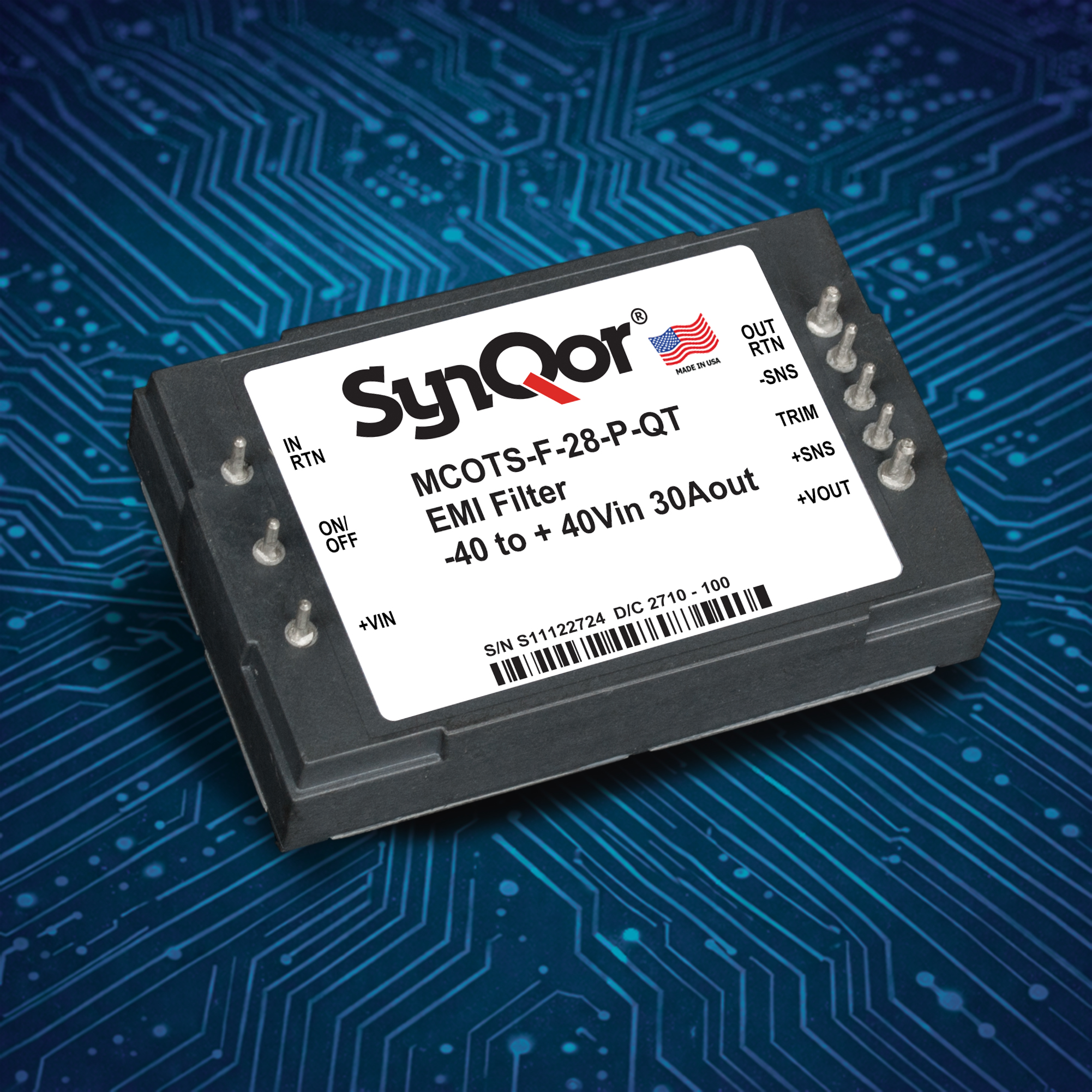



Engineered for 115V / 230V fixed 400Hz and wide variable-frequency (360 Hz – 800 Hz) aircraft power grids. AeroQor® line filters deliver maximum insertion loss, minimal power dissipation, and total EMC compliance for mission-critical airborne electronics.
System integrators and power design engineers face unprecedented electromagnetic challenges when interfacing Line Replaceable Units (LRUs) with aircraft AC buses. Here is how specialized Avionics AC Line Filters overcome the physics limits of standard commercial EMI filters.
Legacy military aircraft predominantly operate on a fixed 400 Hz AC power grid. However, modern commercial platforms such as the Boeing 787 Dreamliner and Airbus A350—as well as next-generation More Electric Aircraft (MEA) and eVTOL architectures—utilize Variable Frequency (VF) AC generators operating between 360 Hz and 800 Hz. This dynamic frequency swing introduces profound challenges for traditional AC line filters:
In airborne applications, safety regulations impose strict limits on maximum AC ground leakage current (Y-capacitor leakage) to protect aircraft airframe bonding and avoid interfering with ground fault detection units. System engineers frequently ask: "How do we achieve RTCA/DO-160G Category H/P conducted emission attenuation without exceeding micro-ampere earth leakage thresholds?"
Standard industrial EMI filters rely on large common-mode Y-capacitors (line-to-ground) to suppress high-frequency noise. In a 115V or 230V 800 Hz system, large Y-capacitors conduct significant reactive current to the chassis, causing thermal dissipation, potential ground loops, and safety qualification failures. SynQor's Avionics AC Line Filters solve this dilemma by utilizing high-permeability, multi-stage common-mode chokes combined with precision differential-mode filtering circuits. This allows us to deliver up to 80 dB of conducted noise suppression while maintaining ground leakage currents well within RTCA/DO-160G and Airbus ABD0100 allowable envelopes.
Airborne power buses are subject to harsh electrical transients caused by switching heavy inductive loads, power transfer switching between APU and main generators, and indirect lightning strikes. An effective Avionics AC Line Filter is not merely a passive noise suppressor—it is the first line of defense for downstream Power Factor Correction (PFC) modules and DC-DC converters.
| Transient Test Parameter | RTCA/DO-160G & MIL-STD Standard | AeroQor® Integrated Filter Protection Feature |
|---|---|---|
| Lightning Transient Induced Spikes | Section 22 (Pin Injection & Cable Bundle Waveforms 1-5B) | Multi-stage TVS clamp networks capable of absorbing high energy pulses up to Level 5 requirements. |
| Voltage Surges & Interruptions | Section 16 (115V / 230V AC Cat A, B, & Z transients) | Controlled inrush current limiting and high surge voltage rating withstand up to 750V peak transients. |
| Audio Frequency Conducted Susceptibility | Section 18 (Ripple & Harmonics from 10 Hz to 150 kHz) | Low-frequency differential rejection networks designed to prevent harmonic distortion from passing into DC buses. |
| Conducted Radio Frequency Interference | Section 21 (Category B, H, & L Conducted Emissions) | Attenuates conducted switching noise from 150 kHz to 152 MHz down to stringent aircraft baseline noise floors. |
Whether you require standalone EMI suppression or a complete AC-DC front-end power architecture, SynQor provides fully qualified, brick-format line filters engineered for immediate integration into airborne equipment.
Half-brick active EMI filter for 115V/230V AC lines. Provides complete RTCA/DO-160G Category H emission compliance across 360-800 Hz variable frequencies with low ground leakage.
Request Technical DataFull-brick 3-phase AC line filter engineered for 115Vrms line-to-neutral or 200Vrms line-to-line aircraft networks. Integrated transient protection against MIL-STD-704 spikes.
Request 3-Phase Specs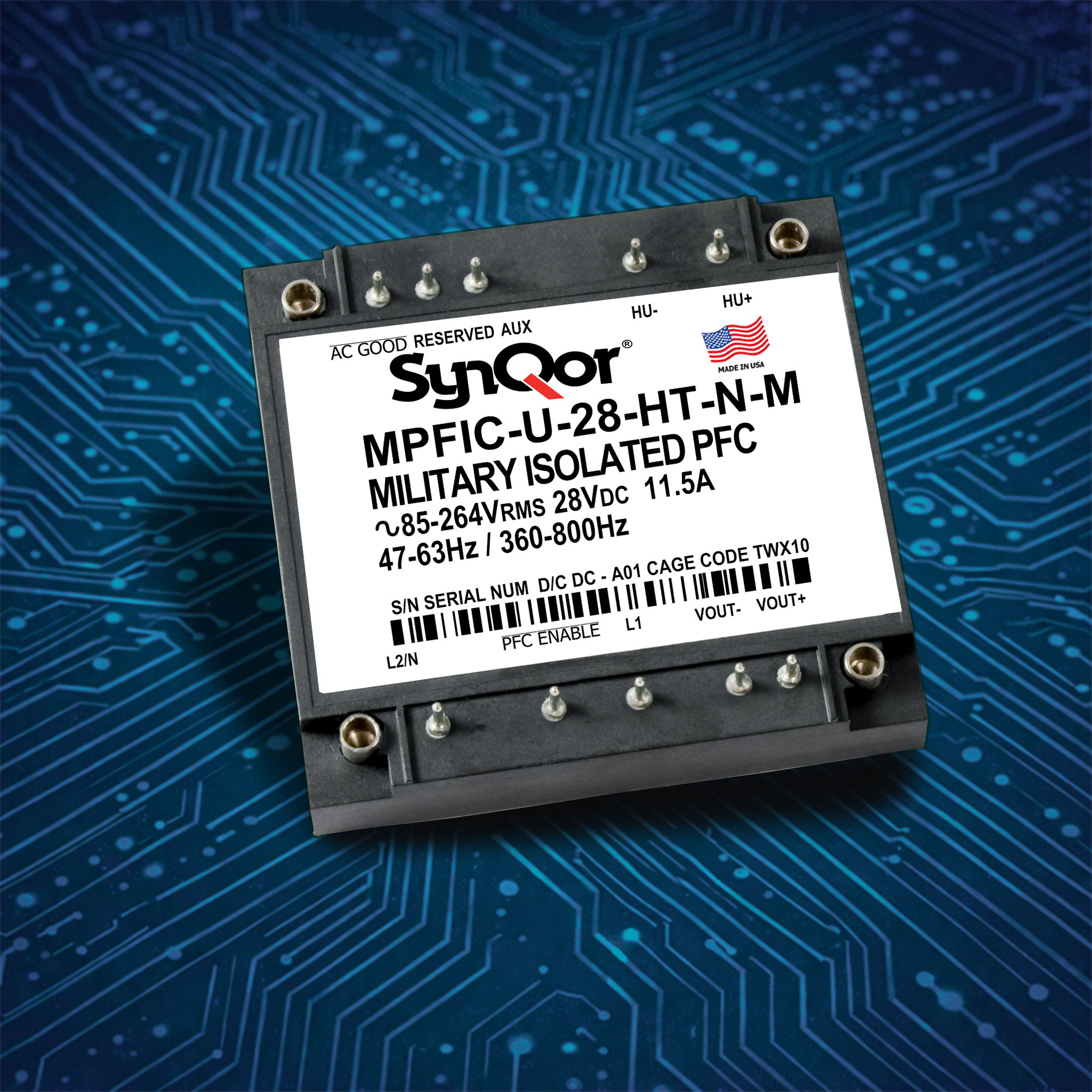
Combines active Power Factor Correction (PFC) with integrated line filtering in a sealed module. Achieves 0.99 power factor and low THD under DO-160G environment.
View Isolated AC-DC Modules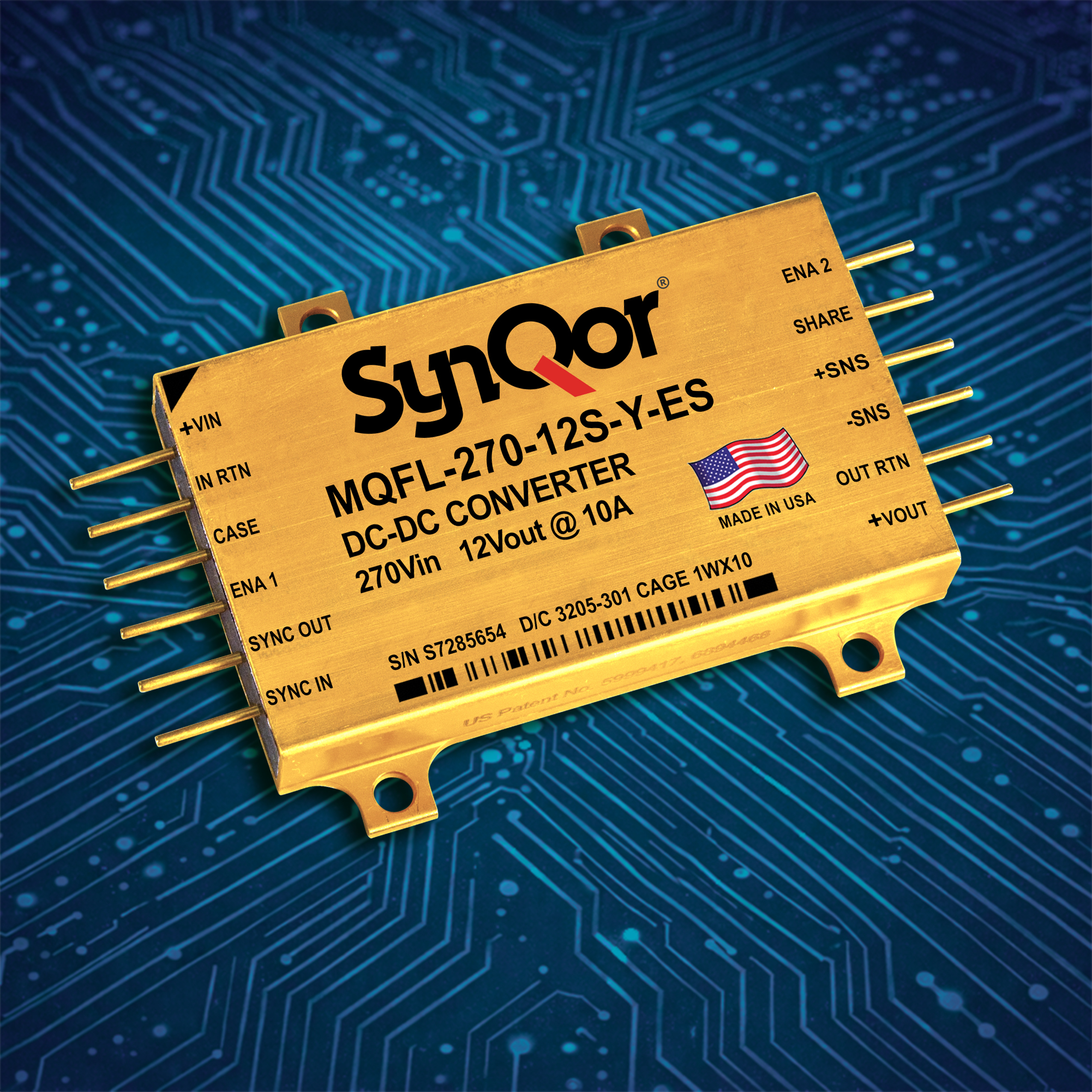
1U sealed rackmount uninterruptible power supply (UPS) featuring embedded AeroQor 3-phase AC line filters, active power factor correction, and battery hold-up.
Explore Rackmount Systems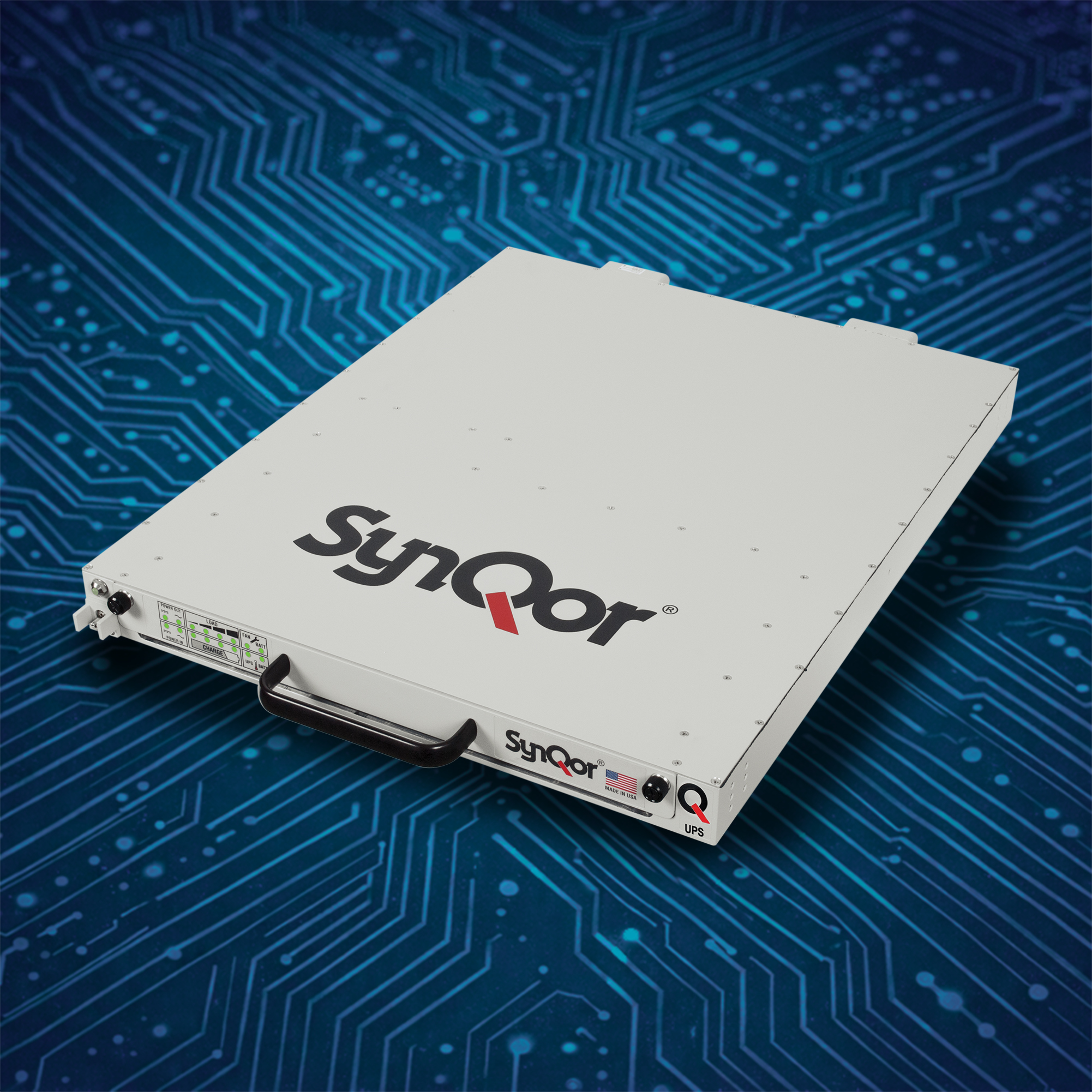
As global aerospace primes transition toward More Electric Aircraft (MEA), Urban Air Mobility (eVTOL), and modern military radar platforms, procurement strategies for AC line filters are undergoing structural changes.
To reduce heavy copper wiring harness weight across modern airframes, aerospace designers are migrating from legacy 115V AC distribution to 230V AC wide-frequency grids. Higher operating voltages reduce line current and line loss, but they significantly increase insulation stress, corona discharge risk at high altitudes (DO-160G Section 4), and common-mode dv/dt noise. Future filter procurement requires units specifically qualified for elevated isolation dielectric withstand (over 2000Vrms) and reinforced potting encapsulation to eliminate partial discharge in unpressurized avionics bays up to 70,000 feet.
Next-generation avionics power supplies, actuator drives, and radar transmitters are rapidly adopting Silicon Carbide (SiC) and Gallium Nitride (GaN) power transistors operating at switching speeds above 500 kHz – 2 MHz. While WBG devices drastically increase conversion efficiency, their ultra-fast switching rise times (high dv/dt and di/dt) radiate intense high-frequency EMI. Procurement engineers can no longer rely on simple low-pass choke networks; modern Avionics AC Line Filters must provide linear attenuation extended up to 10 GHz to protect sensitive airborne communications and navigation avionics.
Historically, procurement teams sourced AC filters, transient surge suppressors, and PFC modules from separate component vendors. This fragmented approach frequently led to impedance mismatch, unexpected LC ringing, and compliance test failures during final aircraft integration. Modern aerospace procurement is heavily shifting toward pre-matched filter-and-converter pairs. Sourcing an integrated module chain—where the filter's output impedance matches the PFC stage's negative dynamic input impedance—eliminates engineering risk and shortens DO-160 qualification schedules by months.
Geopolitical turbulence and international trade regulations (such as ITAR, DFARS, and FAR compliance) have made global defense and aerospace OEMs re-evaluate overseas supply chains. Defense primes now prioritize suppliers with 100% domestic U.S. manufacturing facilities, AS9100 quality certification, and complete component traceability. SynQor’s facility in Salem, New Hampshire provides aerospace procurement officers with total confidence, guaranteeing long-term product availability, form-fit-function replacement paths, and zero component counterfeiting risks.
SynQor’s process-centered engineering discipline ensures that every AeroQor® Avionics AC Line Filter delivers identical EMI attenuation and thermal performance over decades of operational service.
Pioneered commercial synchronous rectification in high-efficiency power converters. Our active filter architectures achieve electrical efficiency up to 99%, keeping thermal dissipation minimal in sealed enclosures.
All AeroQor® modules are designed, qualified, and built under one roof in Salem, New Hampshire, USA—providing full ITAR compliance, AS9100D control, and direct engineering access.
We support defense and aerospace programs spanning 20+ years. SynQor guarantees legacy support, detailed derating reports, and form-fit-function replacement modules to prevent costly system redesigns.
Synthesized from real inquiries submitted by global aerospace procurement specialists, EMI compliance engineers, and system integrators.
While MIL-STD-461 focuses primarily on conducted and radiated emission limits for military ground and naval equipment, RTCA/DO-160G imposes specific airborne environmental, power quality, and transient immunity requirements unique to civil and military aircraft. Dedicated Avionics AC Line Filters (such as SynQor’s AeroQor® series) are specifically engineered to accommodate variable frequency operation (360 Hz to 800 Hz), stringent earth leakage current limits for airframe safety, audio-frequency susceptibility (Section 18), and high-energy lightning surge waveforms (Section 22) that standard industrial or military DC/AC filters do not address.
As AC line frequency increases from 50/60 Hz up to 800 Hz, the capacitive reactance ($Z_C = 1 / (2\pi f C)$) of Y-capacitors (line-to-ground) decreases proportionally. This causes reactive leakage current flowing to the aircraft chassis to increase up to 13 times compared to standard commercial grids. If an engineer uses a generic filter with high line-to-ground capacitance, ground leakage will exceed RTCA/DO-160G limits, risking shock hazards and ground fault tripping. SynQor AeroQor filters utilize high-inductance nanocrystalline common-mode chokes with minimal Y-capacitance, maintaining superior EMI suppression while strictly controlling ground leakage current below safety thresholds across all operating frequencies.
Yes. SynQor AeroQor line filters feature integrated multi-stage surge suppression networks designed to absorb severe transient energy from lightning events (Pin Injection and Cable Bundle tests per DO-160G Section 22 Waveform sets 1-5B up to Level 5). Additionally, they withstand input voltage transients up to 750V peak without degradation or output interruption, providing robust defense for downstream PFC circuits and DC-DC power converters.
When an EMI filter and a switching converter are sourced independently, their internal LC networks can interact negatively, causing high-Q resonant impedance peaking that degrades EMI performance or creates system instability. SynQor designs and pre-qualifies AeroQor filters and AeroQor isolated AC-DC/PFC converters as a matched power system chain. Operating the pair together guarantees system compliance with RTCA/DO-160G (Sections 16, 17, 18, and 21) and Airbus/Boeing specifications out of the box, drastically reducing pre-compliance test iterations and engineering costs.
AeroQor® Avionics AC Line Filters are housed in fully potted, metal-baseplate brick packages (half-brick and full-brick standards). They are engineered for conduction cooling via cold plates or heat-sinking mounting surfaces inside sealed, unpressurized LRU chassis. The encapsulated design offers immunity against extreme thermal shock, humidity, altitude (up to 70,000 ft), and mechanical vibration (DO-160G Section 8). Baseplate options include flanged, non-flanged, and threaded insert configurations.
SynQor owns and operates its complete manufacturing infrastructure in Salem, New Hampshire, USA under AS9100D and ISO-9001 certifications. We maintain long-term relationships with qualified component distributors, enforce strict anti-counterfeiting incoming inspection protocols, and maintain extensive raw material reserves. For long-lifecycle aerospace programs, SynQor guarantees form-fit-function replacement guarantees and direct access to application engineering teams for derating, thermal modeling, and lifetime support.
Send our application team your aircraft AC bus requirements (115V/230V, 400Hz/VF), load specifications, and thermal boundaries. Our Salem, NH engineering team will evaluate your filter-and-converter chain before layout commitment.


