
3-Phase MPFIC Modules
Isolated 3-phase Power Factor Correction modules delivering up to 1500W in a compact full-brick package. Designed for 115Vrms line-to-line systems across 45-800Hz environments.
Explore MPFIC Line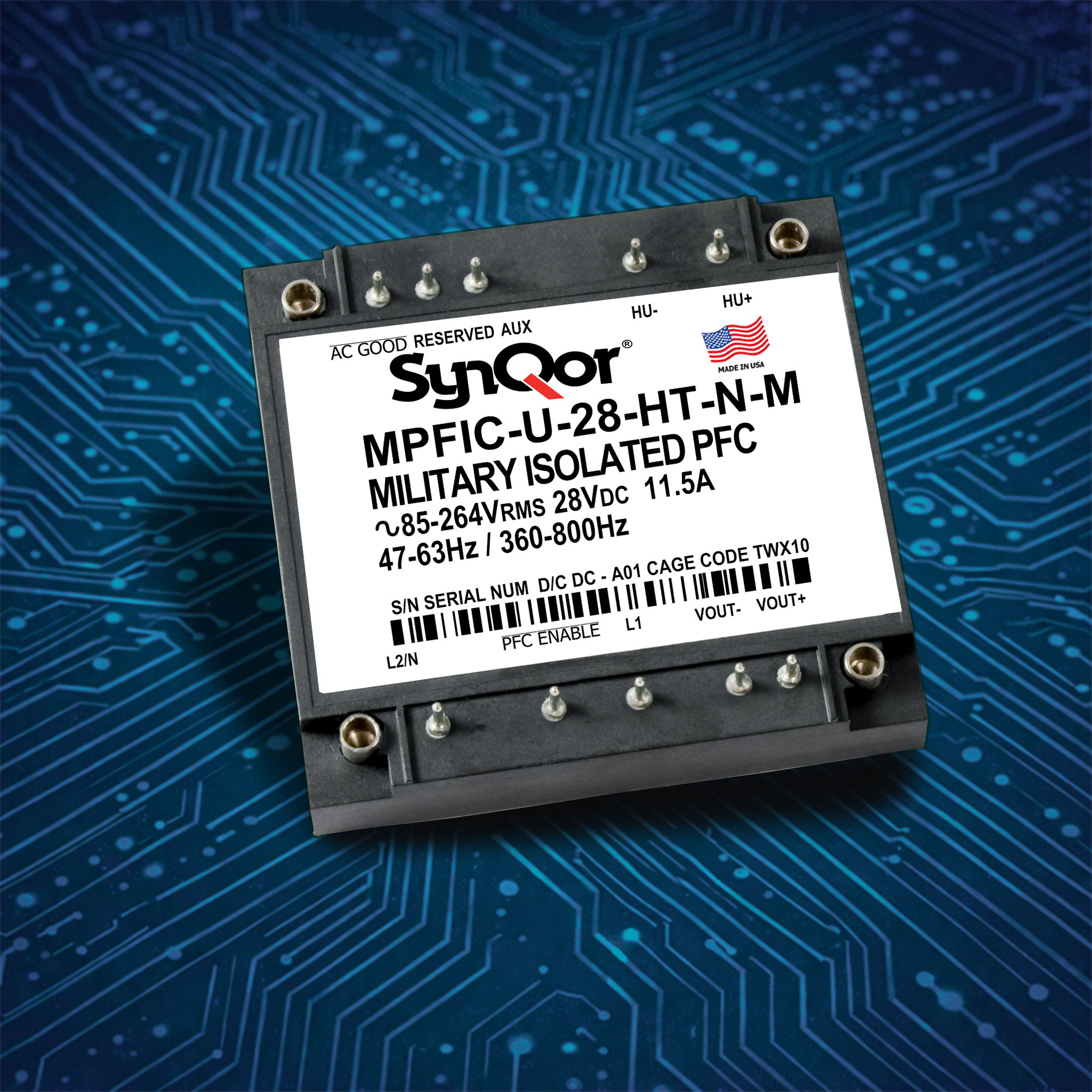



A definitive guide for defense procurement managers and lead power architects on selecting, integrating, and optimizing field-proven Mil-COTS AC-DC modules with active Power Factor Correction (PFC), certified against MIL-STD-704, MIL-STD-1399, MIL-STD-461, and RTCA DO-160.
Navigating the rigorous electromagnetic and thermal environments of modern defense platforms demands power conversion hardware engineered specifically to prevent single-point line failures, eliminate harmonic pollution, and maximize conversion density.
In contemporary military program procurement, the transition toward Commercial Off-The-Shelf (COTS) solutions—specifically Mil-COTS AC-DC Converters—represents a paradigm shift. Rather than committing multi-million dollar engineering budgets to fully custom, non-recurring engineering (NRE) power supplies, defense OEMs and system integrators leverage standardized, high-density brick building blocks. These modules deliver full compliance with complex defense standards while drastically accelerating time-to-deployment for tactical ground vehicles, shipboard radar arrays, and fixed-wing or rotary aircraft.
Isolated 3-phase Power Factor Correction modules delivering up to 1500W in a compact full-brick package. Designed for 115Vrms line-to-line systems across 45-800Hz environments.
Explore MPFIC LineHigh-efficiency single-phase AC-DC converters with active power factor correction, operating across universal 85-264Vrms inputs with tightly regulated isolated output buses.
Explore MACDC Line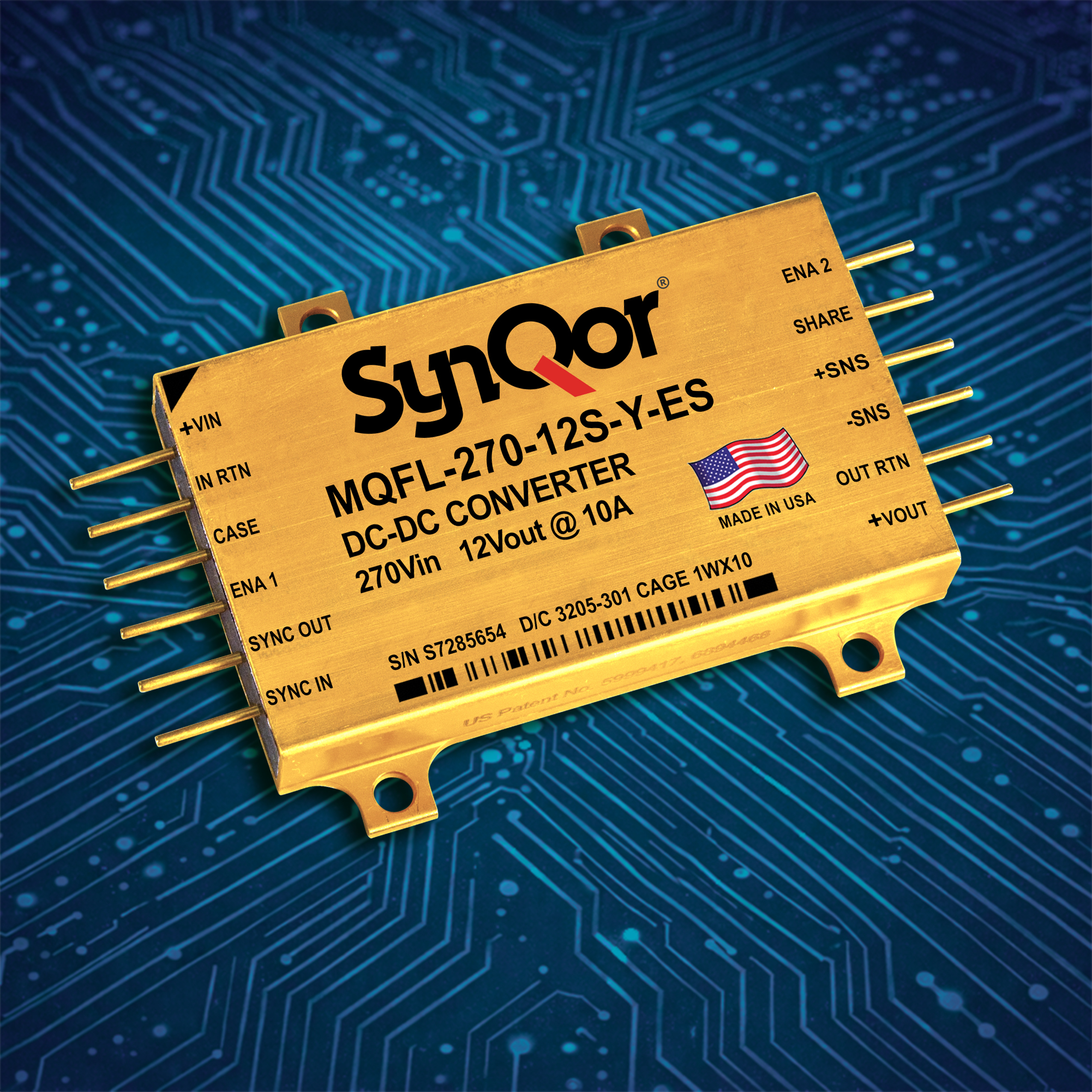
Low-pass power line filters specifically matched to Mil-COTS AC-DC front ends to ensure complete system compliance with MIL-STD-461 (C-F) conducted emissions.
Explore EMI Filters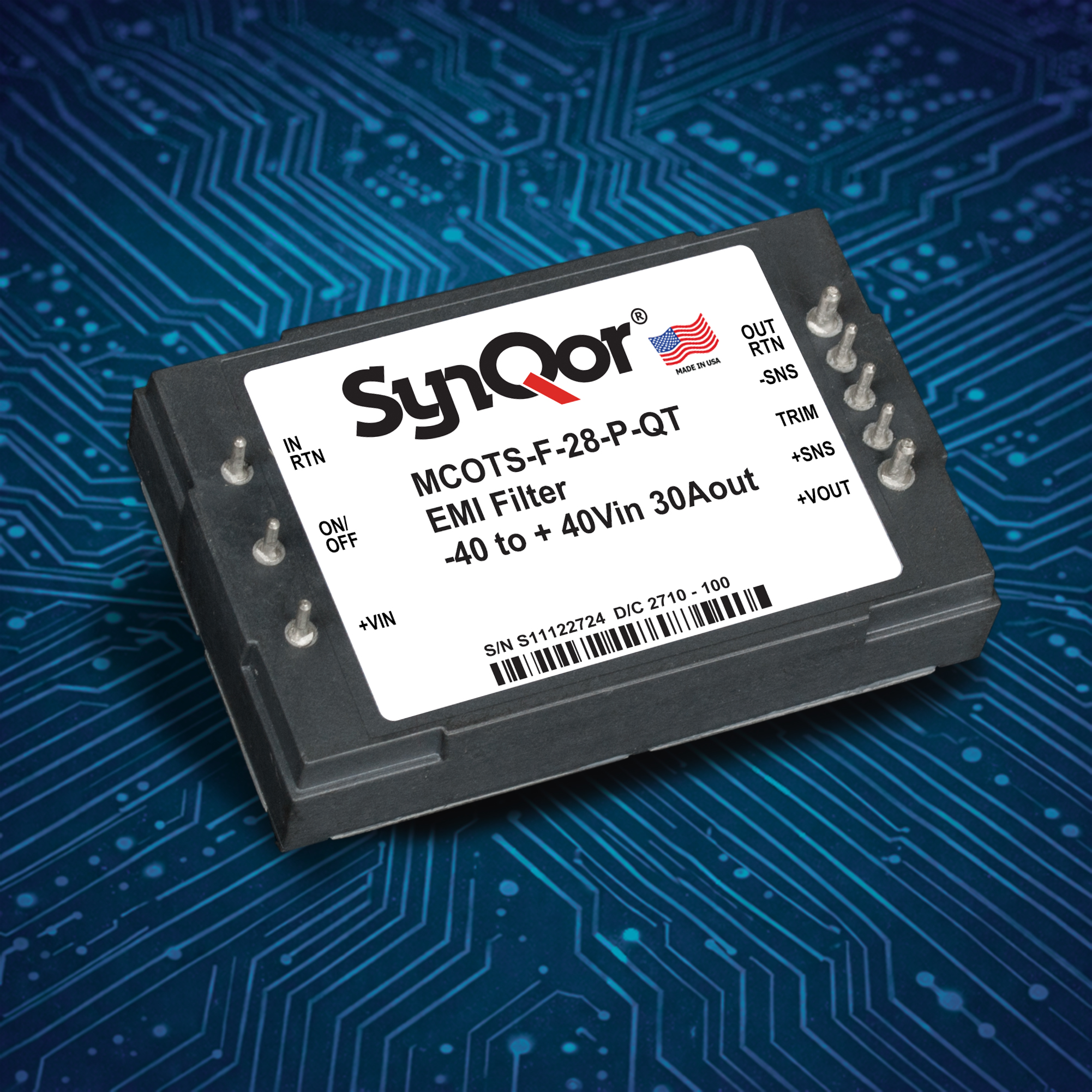
Rack-mount and system-level 1U-3U uninterruptible power supplies built on internal Mil-COTS AC-DC and DC-DC converter blocks with integrated battery backup.
Explore UPS Systems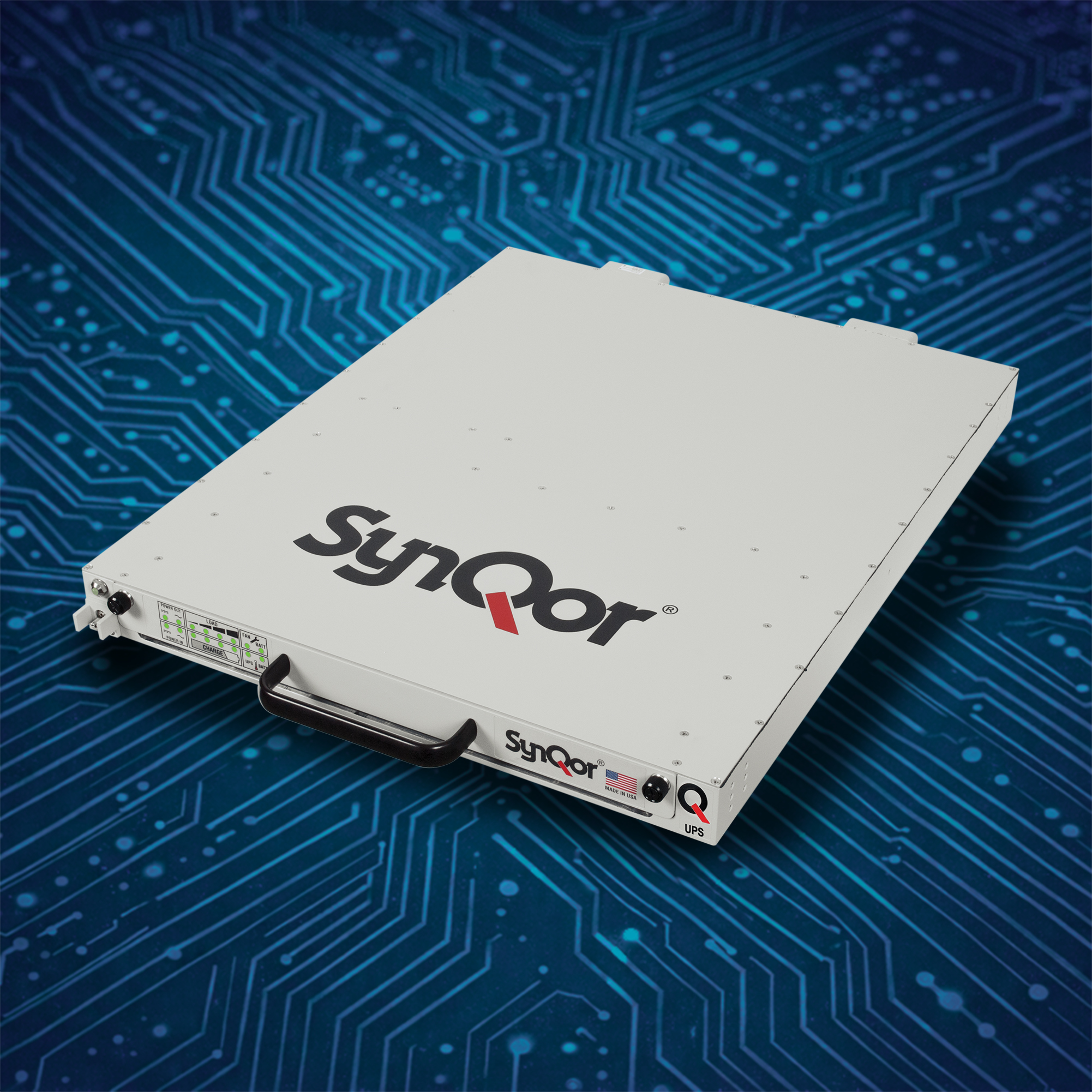
SynQor’s Mil-COTS AC-DC product portfolio is built around a proprietary two-stage topology featuring active Power Factor Correction and synchronous rectification. Unlike traditional single-stage AC-DC power supplies that experience severe thermal concentration and poor efficiency under variable line frequencies, SynQor's modular approach decouples line regulation from output stage DC-DC transformation.
| Product Line | Input Voltage Range | Line Frequency | Output Power / Voltage | Efficiency | Key Military Standards |
|---|---|---|---|---|---|
| MPFIC 3-Phase Isolated | 80 - 135 Vrms L-L (3-Phase) | 47 - 800 Hz (Variable) | Up to 1500W (28V, 48Vdc) | 94% - 95.5% | MIL-STD-704(A-F), MIL-STD-1399-300B, MIL-STD-461 |
| MACDC Single-Phase | 85 - 264 Vrms (Single-Phase) | 47 - 63 Hz / 360 - 800 Hz | 750W - 1000W (12V, 28V, 48Vdc) | 92% - 94% | MIL-STD-704F, RTCA DO-160G, EN 61000-3-2 |
| High-Power PFC Front End | 85 - 264 Vrms (Universal) | 47 - 800 Hz | Up to 1500W Non-Isolated Bus | 96% | MIL-STD-461F/G with companion filter |
On naval surface combatants and submarines adhering to MIL-STD-1399 Section 300B, line-to-line 3-phase delta power systems often suffer from severe phase current unbalance when single-phase AC-DC loads are applied across phase pairs. SynQor's MPFIC modules solve this by utilizing a true 3-phase active power factor correction topology that draws equal, sinusoidal currents from all three phases simultaneously. This eliminates line-frequency neutral currents, reduces harmonic distortion (THD < 2.5%), and prevents voltage drop unbalance across shipboard distribution buses.
Analyzing supply chain security, standardized open architecture mandates, and total lifecycle cost management for global defense prime contractors.
Global defense procurement agencies (including the U.S. DoD, NATO forces, and allied ministries of defense) are strictly enforcing the Modular Open Systems Approach (MOSA) and Sensor Open Systems Architecture (SOSA) standards. Power architectures are transitioning away from proprietary custom bricks toward standardized Mil-COTS AC-DC and DC-DC form factors that feature drop-in compatibility, enabling rapid hardware refreshes without requalifying the entire enclosure.
With heightened geopolitical tensions, prime contractors are actively auditing component provenance. Procurement standards now heavily weigh National Defense Authorization Act (NDAA) compliance, TAA compliance, and domestic U.S. manufacturing capabilities. Sourcing Mil-COTS AC-DC converters engineered and built in U.S. AS9100-certified facilities mitigates risks of unexpected export controls, counterfeit component injection, and long-lead supply chain disruptions.
Modern defense payloads—such as active electronically scanned array (AESA) radars, high-energy laser rangefinders, and electronic warfare (EW) jamming suites—require high peak power. Traditional 28V DC distribution networks suffer from heavy copper cable weight and elevated ohmic losses ($I^2R$). Procurement trends indicate a massive shift toward higher-voltage intermediate DC buses (such as 48V or 270V DC), where Mil-COTS AC-DC front-ends step line voltage down directly to 48V, followed by localized point-of-load (POL) converters.
When evaluating Mil-COTS AC-DC converters, sophisticated defense procurement teams perform comprehensive TCO analyses rather than selecting hardware based strictly on initial unit cost. The true financial and operational cost of a military power supply spans four major vectors:
How active power factor correction, high-frequency topology designs, and synchronous rectification redefine power density boundaries.
Legacy military AC-DC converters relied on passive inductive filtering to achieve basic power factor compliance on 60 Hz or 400 Hz lines. However, modern aircraft electrical architectures utilize variable-frequency AC generators where line frequencies dynamically shift between 360 Hz and 800 Hz depending on engine turbine RPM. Passive filters designed for 400 Hz suffer severe impedance shifts, leading to degraded power factor, unacceptable THD, and excessive weight.
SynQor’s Mil-COTS AC-DC converters utilize digital signal processing (DSP)-controlled active boost topologies that dynamically track line frequency in real time. By adjusting switching cycles packet-by-packet, the converter maintains a power factor > 0.98 and THD < 3% across the entire 360-800 Hz range, satisfying RTCA/DO-160G Section 16 and MIL-STD-704F without requiring heavy external inductors.


At the core of SynQor’s design philosophy is the commercialization of synchronous rectification in military power modules. In traditional secondary-side output rectification, diodes exhibit a non-linear forward conduction voltage drop ($V_f \approx 0.7\text{V} - 1.0\text{V}$). In a 28V, 50A output system, diode conduction losses alone exceed 35 Watts to 50 Watts of pure thermal waste.
By replacing rectifier diodes with custom-driven power MOSFETs featuring RDS(on) resistance in the single-digit milliohm range, conduction losses drop exponentially. This innovation reduces internal module power dissipation by up to 75%, allowing full-power conversion in high-temperature baseplate environments without requiring noisy external cooling fans or liquid chillers.
Because Mil-COTS AC-DC converters operate at efficiencies up to 95-96%, internal thermal stress is dramatically reduced. Component junction temperatures ($T_j$) remain well within conservative derating curves, directly yielding Mean Time Between Failures (MTBF) figures exceeding 1.5 million hours at +55°C baseplate temperatures per MIL-HDBK-217F.
Engineering excellence, rigorous process discipline, and complete operational transparency from initial design to long-term operational sustainment.
All engineering design, environmental stress screening (ESS), qualification testing, and volume automated assembly take place in SynQor's state-of-the-art facility located in Salem, New Hampshire, USA. Prime contractors benefit from full supply chain visibility, ITAR compliance capability, and direct access to design engineers.
SynQor operates a process-centered organization that systematically exceeds basic ISO-9001 and AS9100 aerospace quality guidelines. Every production unit undergoes rigorous automated optical inspection (AOI), full-spectrum electrical testing, thermal cycling, and high-pot isolation screening prior to shipment.
Founded by MIT professor Dr. Martin F. Schlecht in 1997, SynQor revolutionized the DC-DC and AC-DC power converter industry by pioneering synchronous rectifier technology. That legacy of academic rigor and hardware innovation continues across all defense, aerospace, rail, and medical product lines.
In-depth technical answers addressing common design challenges, regulatory standards compliance, and mechanical integration for defense power systems.
SynQor Mil-COTS AC-DC converters employ high-frequency active power factor correction (PFC) topologies utilizing advanced DSP control algorithms. These algorithms dynamically track phase currents relative to non-sinusoidal or frequency-varying line voltages across the entire 360 Hz to 800 Hz spectrum mandated by RTCA/DO-160G and MIL-STD-704F. This guarantees a power factor exceeding 0.98 and total harmonic distortion (THD) below 3%, preventing destructive resonance and phase imbalance on the aircraft main AC bus.
Single-stage non-isolated PFC modules boost input line voltage to an non-isolated high-voltage DC bus (typically 380V-400V), requiring downstream isolated DC-DC converters to provide safety isolation and regulated low voltages. SynQor MPFIC modules integrate active 3-phase power factor correction with galvanic isolation within a single, high-density full-brick enclosure. This provides isolated 28V, 48V, or custom DC outputs directly from a 3-phase 115Vrms line-to-line AC supply, eliminating intermediate bus losses, reducing component count, and simplifying system-level thermal management.
MIL-STD-1399 Section 300B governs electric power energy limits, harmonic limits, and spike susceptibility for shipboard equipment. SynQor shipboard AC-DC modules feature extremely low input current harmonics, active inrush current limiting, and balanced 3-phase delta/wye current draw. When paired with SynQor companion EMI filters, the power conversion stage tolerates 2500V line transients, zero-voltage dips, and line frequency shifts without interrupting output voltage regulation or tripping over-voltage protections.
Traditional diode rectifiers suffer from fixed forward-voltage drops (0.7V to 1.0V), which dissipate massive power at high output currents (e.g., 50A to 100A). SynQor engineered synchronous rectification replaces lossy Schottky diodes with low RDS(on) power MOSFETs controlled by high-speed gate drives. This cuts conduction losses by up to 75%, allowing full-power conversion efficiency up to 95-96%. Lower internal thermal dissipation reduces baseplate-to-ambient temperature deltas, enabling reliable conduction-cooled operation up to +100°C baseplate temperatures without forced air.
MIL-STD-704 specifies power interruption transients where AC line input can drop to zero for up to 50 milliseconds (or longer for specific mission profiles). SynQor AC-DC converters provide dedicated hold-up high-voltage pins or integrated hold-up management circuits. Because energy storage in a capacitor scales with the square of the voltage ($E = \frac{1}{2} C V^2$), storing hold-up energy at an internal elevated DC bus voltage drastically minimizes the required physical capacitance volume compared to storing hold-up at 28V DC outputs.
MIL-STD-461 enforces strict limits on conducted emissions (CE101 and CE102) from 30 Hz to 10 MHz. SynQor designs companion EMI filter modules specifically tuned to the differential-mode and common-mode switching frequencies of our Mil-COTS AC-DC front-ends. By characterizing the filter and converter as a unified system chain, designers avoid filter-converter impedance mismatch oscillations, achieving guaranteed CE102 compliance on the first test pass without adding redundant multi-stage external filter components.
Submit your electrical bus specifications, environmental profiles, and target military standards. Our Senior Application Engineers in Salem, NH will perform a comprehensive power chain evaluation and supply complete qualification documentation.


