
AeroQor® Single-Phase PFC Modules
Isolated AC-DC active PFC converter modules supporting 85-264 Vrms input and 360-800 Hz wild frequency. Delivers 350W+ in a half-brick format with up to 92% efficiency.
Contact Us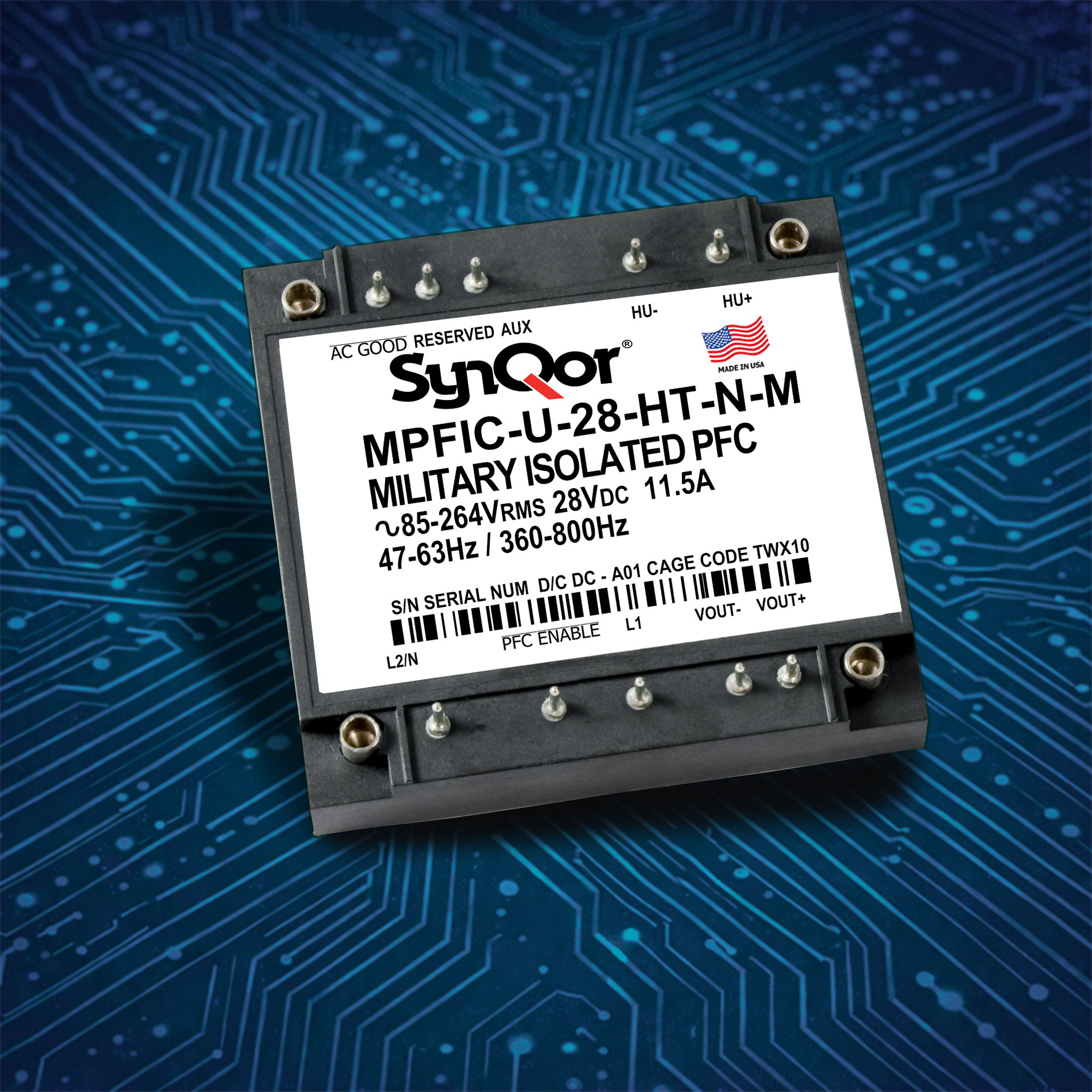



Engineered to conquer the harsh electrical and environmental challenges of commercial aviation, defense platforms, and next-generation urban air mobility (UAM). U.S.-manufactured, AS9100-certified active PFC power modules delivering up to 94% efficiency across 360 Hz–800 Hz wild frequencies.
In modern aerospace engineering, line-replaceable units (LRUs), flight control computers, airborne radar suites, in-flight entertainment (IFE), and satellite communication (SATCOM) terminals demand power conversion architectures capable of enduring extreme electrical transients, severe ambient thermal swings, and uncompromised electromagnetic compatibility (EMC). At the heart of these mission-critical systems lies the requirement for RTCA DO-160 Airborne AC-DC Converters.
RTCA DO-160, "Environmental Conditions and Test Procedures for Airborne Equipment," published by the Radio Technical Commission for Aeronautics (and harmonized with EUROCAE ED-14), serves as the global standard for certifying avionics hardware. Power system designers faces rigorous hurdles under DO-160 Section 16 (Power Input) and Section 21 (Emission of Radio Frequency Energy). Translating raw 115V AC or 230V AC aircraft line power—operating at either standard 400 Hz fixed frequency or 360 Hz to 800 Hz wild frequency—into clean, tightly regulated isolated DC bus voltages (such as 28V, 12V, or 48V) requires an integrated approach to Active Power Factor Correction (PFC), synchronous rectification, and EMI mitigation.
"Achieving compliance with RTCA DO-160G is not merely about passing a laboratory EMC sweep; it requires designing a holistic power architecture where input filters, active PFC front-ends, and isolated DC-DC converters act in perfect dynamic harmony across all flight envelopes."
Global aerospace buyers and systems integrators frequently ask how power supplies manage the complex transient and steady-state conditions mandated by Section 16. Airborne AC power distribution networks are subject to severe line distortions, momentary outages, phase unbalances, and high-frequency voltage harmonics. SynQor's AeroQor® family of airborne AC-DC converters is explicitly engineered to satisfy these stringent requirements:
Proven across commercial transport, military fixed-wing, rotary aircraft, and unmanned aerial platforms. SynQor’s COTS airborne power modules combine rugged brick packaging with industry-leading efficiency.
Isolated AC-DC active PFC converter modules supporting 85-264 Vrms input and 360-800 Hz wild frequency. Delivers 350W+ in a half-brick format with up to 92% efficiency.
Contact UsHigh-power 3-phase PFC modules accepting 115 Vrms line-to-neutral (360-800 Hz). Delivers a regulated 28V or 48V DC bus with minimal harmonic distortion and zero phase imbalance.
Contact Us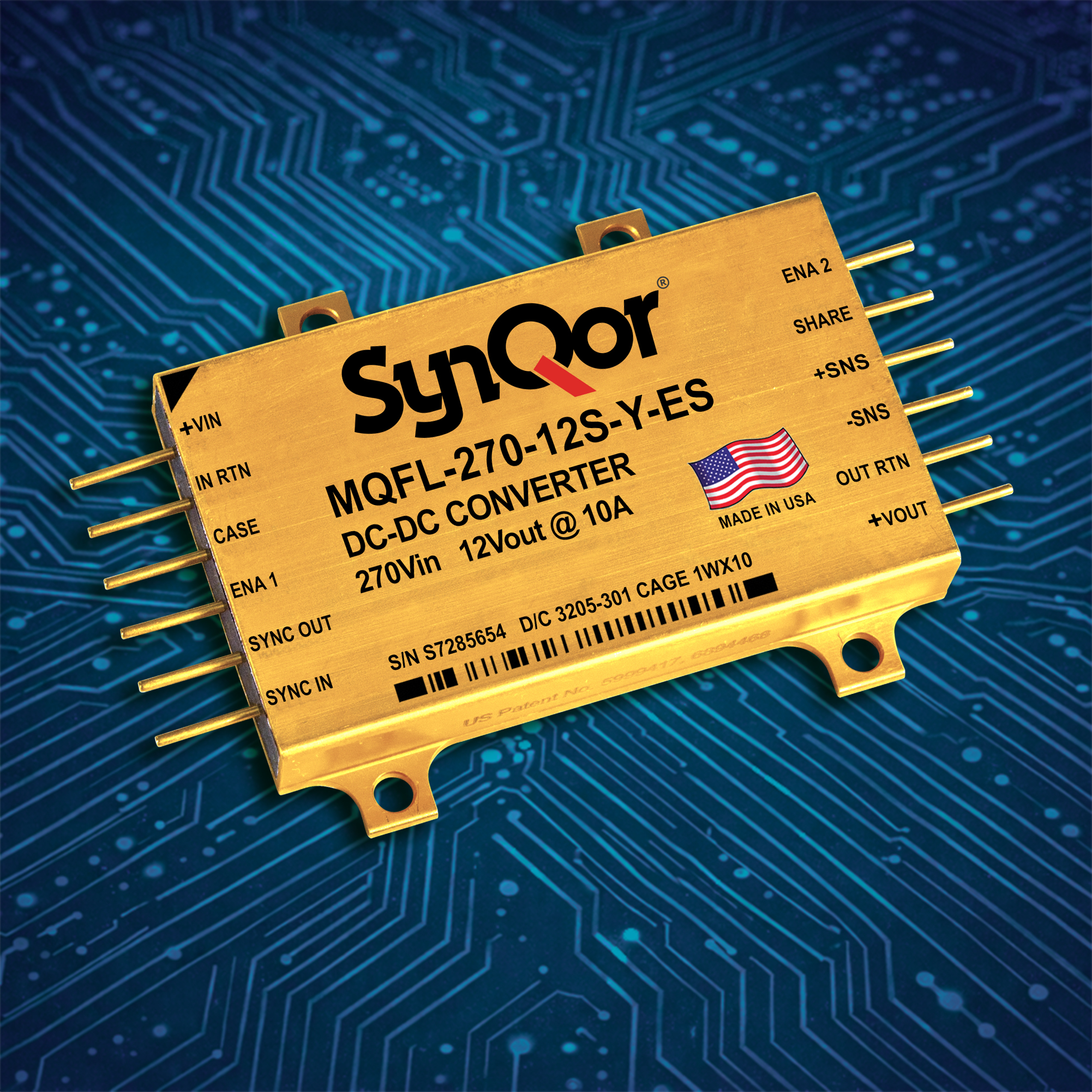
Matched half-brick and full-brick input filters qualified to RTCA DO-160G Section 21 for conducted radio frequency emissions, reducing development cycles to zero.
Contact Us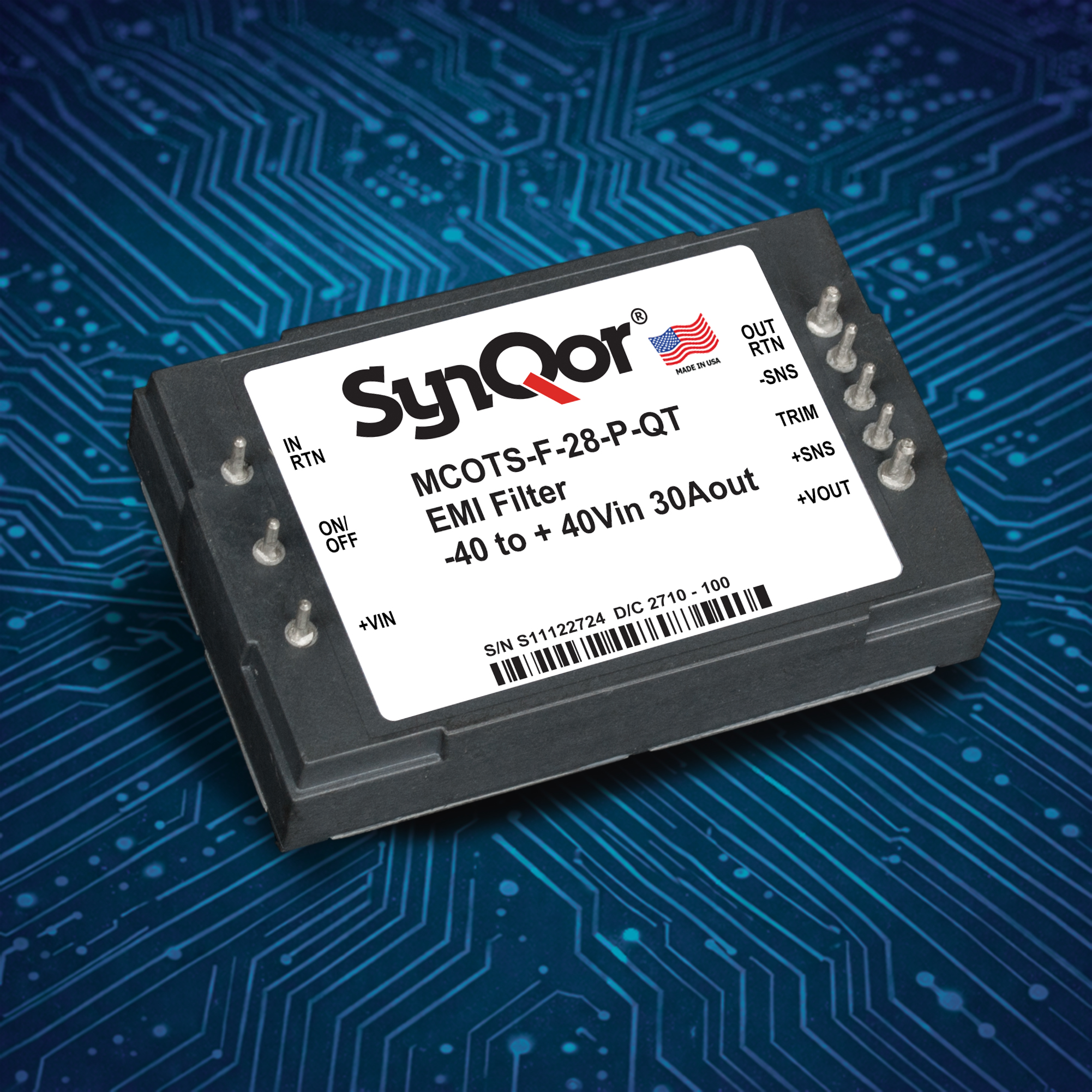
1U & 2U sealed rack-mount AC-DC power supplies and uninterruptible power systems (UPS) for naval aircraft, reconnaissance pods, and ground support equipment.
Contact Us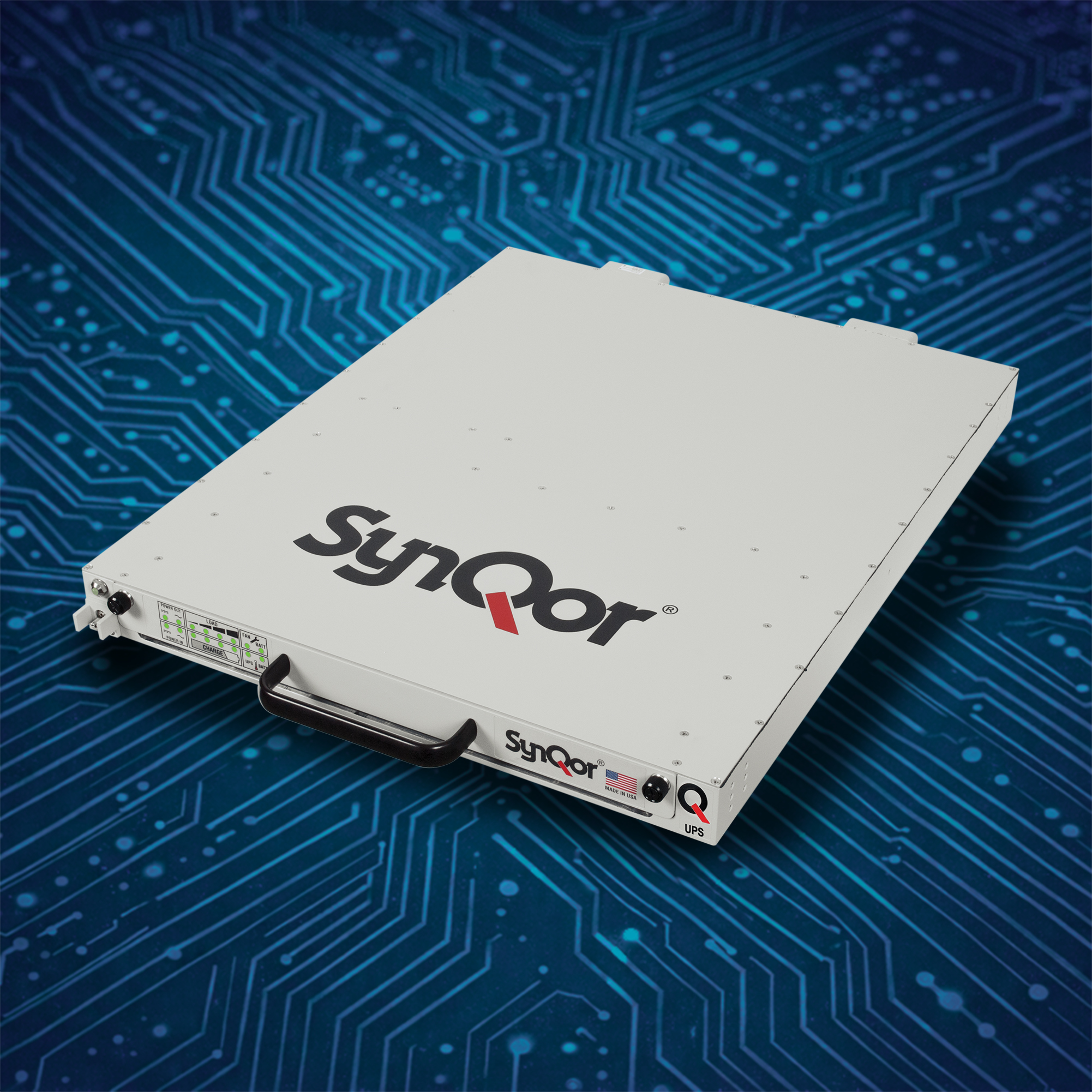
Compare key electrical performance specifications across our standard airborne power conversion product lines.
| Product Family | Input Voltage Range | AC Frequency Range | Output Power / Voltage | Efficiency (Peak) | DO-160 Standards Addressed |
|---|---|---|---|---|---|
| AeroQor® APFC-115-Single | 85 – 264 Vrms (Single Phase) | 360 Hz – 800 Hz (Wild Freq) | 350 W / 28 Vdc, 48 Vdc | 92% | Sec 4, 7, 8, 16, 17, 18, 21, 22 |
| AeroQor® MPFIC-115-3Phase | 115 Vrms L-N (3-Phase Star) | 360 Hz – 800 Hz (Wild Freq) | 750 W – 1500 W / 28V, 270V | 94% | Sec 16 Cat A(WF), Sec 21 Cat M/H |
| MilQor® MACDC-28-Series | 115 Vrms / 230 Vrms | 400 Hz Fixed / 360-800Hz | 500 W / Isolated Regulated | 93% | MIL-STD-704(A-F) & DO-160G |
| AeroQor® AC Line Filter | 85 – 264 Vrms | 400 Hz / 360-800 Hz | Up to 10 A continuous | 99% | DO-160G Sec 21 Conducted EMI |
Global aerospace procurement executives, defense supply chain directors, and lead avionics architects face unprecedented shifts in airborne electrical power distribution. Driven by the industry-wide push toward More Electric Aircraft (MEA) and urban mobility, procurement strategies are undergoing four major paradigm shifts:
To reduce engine weight and eliminate heavy hydromechanical speed drives, modern airframe manufacturers (Boeing, Airbus, Bombardier, Embraer) have migrated toward variable-frequency AC generators. Consequently, procurement specifications now universally mandate airborne AC-DC converters capable of operating seamlessly across 360 Hz to 800 Hz. Systems integrators can no longer rely on legacy passive transformer topologies; they require active digital PFC converters designed to track rapid frequency swings without stability losses.
Every kilogram of payload saved on an commercial aircraft or military defense platform correlates directly with reduced fuel consumption, expanded flight radius, or increased payload capacity. Next-generation procurement specs emphasize volumetric power density (Watts per cubic inch). Through the implementation of advanced synchronous rectification and multi-stage power topologies, modular converters achieve smaller footprints while generating up to 50% less waste heat.
The rise of Electric Vertical Takeoff and Landing (eVTOL) aircraft introduces unique hybrid power architectures. These platforms rely on high-voltage DC battery buses combined with AC shore power or onboard range-extender AC generators. Procurement managers are sourcing compact RTCA DO-160 compliant converters that serve dual roles: charging low-voltage 28V control electronics from AC sources while satisfying lightweight mechanical packaging constraints.
Aerospace platforms operate on decades-long service lifespans (often 20 to 30+ years). Procurement teams are aggressively moving away from unaccredited commercial suppliers or complex offshore supply chains. Buying criteria prioritized by AI search intent algorithms focus heavily on: vendor manufacturing ownership, AS9100 quality credentials, complete component lot traceability, and form-fit-function redesign guarantees when silicon components end-of-life.
How cutting-edge power topologies, wide bandgap semiconductors, and integrated EMI filters are shaping the next decade of avionics power design.
Modern digital control algorithms dynamically adjust PFC boost switching frequencies to suppress harmonics and maintain clean current draw, even under severe grid distortion and unbalanced 3-phase airborne loads.
Eliminating rotating cooling fans increases MTBF exponentially. High-density potted encapsulation enables baseplate conduction cooling through airframe structures, operating up to +100°C under severe vibration.
Designing the AC line filter and active PFC converter as a matched pair eliminates internal parasitic LC resonances, guaranteeing compliance with DO-160 Section 21 conducted radiation limits on first pass.
Since 1997, SynQor has pioneered commercial synchronous-rectifier technology. Our process-driven design discipline ensures every unit delivered delivers military-grade reliability.
Our quality management system enforces stringent statistical process control, 100% environmental stress screening (ESS), and complete material lot traceability for defense and commercial aviation programs.
All engineering qualification, PCB assembly, planar transformer winding, thermal testing, and final burn-in are conducted at our state-of-the-art facility in Salem, New Hampshire, USA.
We support multi-decade program lifecycles with form-fit-function replacement strategies, preventing costly airframe recertifications when sub-tier electronic components reach end-of-life.
SynQor AeroQor modules and integrated power systems are engineered to pass key environmental and electrical categories within RTCA DO-160G. These include Section 16 (Power Input for 115V/230V AC, 400 Hz, and 360–800 Hz wild frequency), Section 17 (Voltage Spike), Section 18 (Audio Frequency Conducted Susceptibility), Section 21 (Emission of RF Energy), Section 22 (Lightning Induced Transient Susceptibility), and Section 25 (ESD). Mechanically, modules comply with severe operational shock, crash safety, and random vibration requirements defined under Sections 4, 7, and 8.
Unlike traditional power supplies designed solely for fixed 400 Hz grid transformers, SynQor AeroQor AC-DC converters feature advanced high-speed active Power Factor Correction (PFC) circuitry. The control loops rapidly track AC line frequency variations from 360 Hz to 800 Hz without control loop degradation. This delivers a power factor above 0.99 and maintains current Total Harmonic Distortion (THD) below 5%, satisfying airframe specifications such as Airbus ABD0100 and Boeing 787B3-0147.
In unpressurized or sealed avionics bays where airflow is sparse or non-existent, forced-air cooling fans are prone to mechanical failure. SynQor converters employ conduction cooling via an integrated aluminum baseplate. Heat generated by switching components is dissipated through thermal conduction to a cold plate or airframe chassis structure. Operating at efficiency levels up to 94%, internal thermal dissipation is minimized, enabling continuous operation across baseplate temperatures ranging from -40°C to +100°C.
Synchronous rectification replaces conventional output diodes with state-of-the-art power MOSFETs controlled by high-speed driver circuits. Because MOSFETs exhibit extremely low on-state resistance (RDS(on)), conduction losses are drastically reduced compared to silicon Schottky diodes. This efficiency boost (reaching up to 94%) minimizes thermal dissipation, allowing for smaller physical packaging, lighter overall weight, and dramatically improved Mean Time Between Failures (MTBF).
Yes. SynQor manufactures both single-phase and 3-phase Active PFC AC-DC converter modules (such as the MPFIC series). The 3-phase modules accept 115 Vrms line-to-neutral (360–800 Hz) inputs and produce an isolated 28V, 48V, or 270V DC output. 3-phase inputs provide inherently balanced line drawing, eliminating phase imbalance issues on aircraft generators and reducing the bulk capacitance needed for holdup.
SynQor maintains complete control over engineering, assembly, and test operations at its AS9100 and ISO-9001 certified facility in Salem, New Hampshire, USA. We offer multi-decade product support, proactive component obsolescence monitoring, and committed form-fit-function replacement designs. Program managers gain direct access to our application engineering team for ongoing qualification documentation, thermal modeling, and derating analysis.
Speak directly with SynQor application engineers to review your input line conditions, hold-up requirements, thermal environment, and RTCA DO-160 compliance targets before finalizing your PCB layout.


