Military defense electronics powered by SynQor Military Standard EMI Filters
Ruggedized tactical ground vehicle power system with transient surge filter
Industrial and defense automation electronics with low conducted emissions filter
Engineering laboratory qualification testing for MIL-STD-461 conducted noise
Defense Electrical Power Architecture

Military Standard EMI Filters: MIL-STD-461 & MIL-STD-1275 Compliance Engineering, Procurement Trends, and Next-Gen Noise Attenuation

Engineered and manufactured in the USA under AS9100 and ISO-9001 standards. SynQor's Mil-COTS Military Standard EMI Filters provide continuous differential and common-mode noise suppression, 250V surge attenuation, and seamless integration with high-efficiency DC-DC and AC-DC power converters for airborne, land tactical, and naval defense systems.

MIL-STD-461 (C-G)CE101, CE102, CS101, CS114, CS115 & CS116 Compliant
MIL-STD-1275 (A-E)Clamps +100V 50ms surges & +250V 50µs spikes
-55°C to +100°CFull-power baseplate operation without derating
AS9100 / USA100% domestic U.S. manufacturing with full lot traceability
Engineering Architecture

The Critical Role of Military Standard EMI Filters in Harsh Electromagnetic Environments

Modern defense platforms demand flawless electromagnetic compatibility (EMC). High-power switching converters, radar pulses, digital communication links, and heavy inductive loads coexist within confined enclosures, making advanced filtering non-negotiable.

In high-reliability defense systems, power quality is direct operational survival. When procurement officers, lead power architects, and system integration engineers search for Military Standard EMI Filters, they face challenges that extend far beyond standard commercial or industrial filtering specifications. Commercial switch-mode power supplies rely on relatively benign input buses and uniform ambient temperatures. In contrast, tactical land vehicles, fighter jet avionics bay installations, unmanned aerial vehicles (UAVs), and naval combatants operate across violent voltage surges, extreme thermal swings, intense vibrational profiles, and harsh conducted interference environments.

SynQor has established itself as an industry leader in high-efficiency power conversion by pioneering the commercial application of synchronous-rectifier topologies and pre-characterized filter-converter power chains. Achieving compliance with defense standards requires a deep understanding of electromagnetic physics, passive component stability, high-frequency parasitic layout, and active transient suppression mechanisms.

Demystifying Conducted & Radiated Noise in Defense Applications

Electromagnetic Interference (EMI) generated by high-frequency power electronics manifests in two primary operational forms: Conducted Emissions (propagating along power and signal lines) and Radiated Emissions (propagating through free space as electromagnetic waves). Military Standard EMI Filters focus primarily on suppressing conducted noise at the power input boundary to prevent switching harmonics from contaminating the platform's central DC or AC bus, while simultaneously protecting down-stream power converters from aggressive bus transients.

  • Differential-Mode (DM) Noise: Generated between the positive input line and the negative return line, driven by the pulsating input current of switch-mode topologies. DM filters utilize series differential inductors and parallel X-capacitors to bypass high-frequency ripples.
  • Common-Mode (CM) Noise: Generated between both input power lines and the system chassis/earth ground, caused by high dv/dt switching nodes coupling capacitively through component heatsinks or PCB ground planes. CM filters employ toroidal common-mode chokes with balanced windings and Y-capacitors tied to chassis ground.

Comprehensive Defense Standards Compliance Envelope

A true Military Standard EMI Filter must satisfy multiple, highly rigorous military specifications. SynQor's Mil-COTS filter modules are designed, tested, and qualified against the complete spectrum of defense and aerospace power standards:

Standard Key Parameter / Test Method Engineering Mitigation Strategy
MIL-STD-461 (C, D, E, F, G) CE101 (30 Hz - 10 kHz), CE102 (10 kHz - 10 MHz) Conducted Emissions; CS101, CS114, CS115, CS116 Conducted Susceptibility Multi-stage passive LC filtering with tuned damping networks to prevent input resonance and suppress high-frequency switching harmonics below strict limit lines.
MIL-STD-1275 (A, B, C, D, E) 28V DC Land Vehicle Power Characteristics (+100V 50ms surges, +250V 50µs spikes, ripple noise, reverse polarity) Active surge suppression circuitry using heavy-duty silicon transient voltage suppressors (TVS) and series MOSFET pass-elements that clamp over-voltage transients.
MIL-STD-704 (A-F) Aircraft Electrical Power Characteristics (28V DC, 270V DC, 115V AC 400Hz / Variable Frequency) Wide-input tolerance, fast dynamic transient response, and zero degradation under severe bus voltage drops and over-voltage conditions.
RTCA DO-160G Airborne Equipment Environmental & EMC Conditions (Section 16 Power Input, Section 18 Audio Frequency, Section 20/21 EMC) Precision low-pass choke topologies ensuring total harmonic distortion (THD) compliance across 360 Hz – 800 Hz variable frequency airborne AC lines.
MIL-STD-1399 (Sec 300B) Naval Shipboard Interface Requirements for Alternating Current Power Low leakage current designs featuring balanced common-mode capacitive networks to prevent ground fault interrupter tripping on naval vessels.

Filter Input Impedance & System Stability (The Middlebrook Criterion)

One of the most frequent points of failure during vehicle or aircraft EMC qualification is negative dynamic input impedance oscillation. Regulated DC-DC converters act as constant-power loads; as input voltage drops, input current increases, resulting in negative incremental input resistance. When a passive passive EMI filter is inserted between the input source and the converter, the filter's output impedance ($Z_{oF}$) interacts with the converter's input impedance ($Z_{iC}$).

According to the Middlebrook Criterion, if the peak output impedance of the EMI filter approaches or exceeds the input impedance of the DC-DC converter ($|Z_{oF}| \ge |Z_{iC}|$), the closed-loop control system experiences severe phase margin erosion, leading to audible noise, output voltage oscillation, or total system breakdown. SynQor's Military Standard EMI Filters incorporate custom-engineered internal RC damping circuits across filter inductors and capacitors, guaranteeing that $|Z_{oF}| \ll |Z_{iC}|$ across all temperature, line, and load conditions.


Product Portfolio Showcase

Recommended Military Standard EMI Filter Modules & Integrated Power Solutions

Field-proven Mil-COTS filter modules engineered for seamless drop-in integration with SynQor isolated DC-DC converters, AC-DC power modules, and uninterruptible power systems.

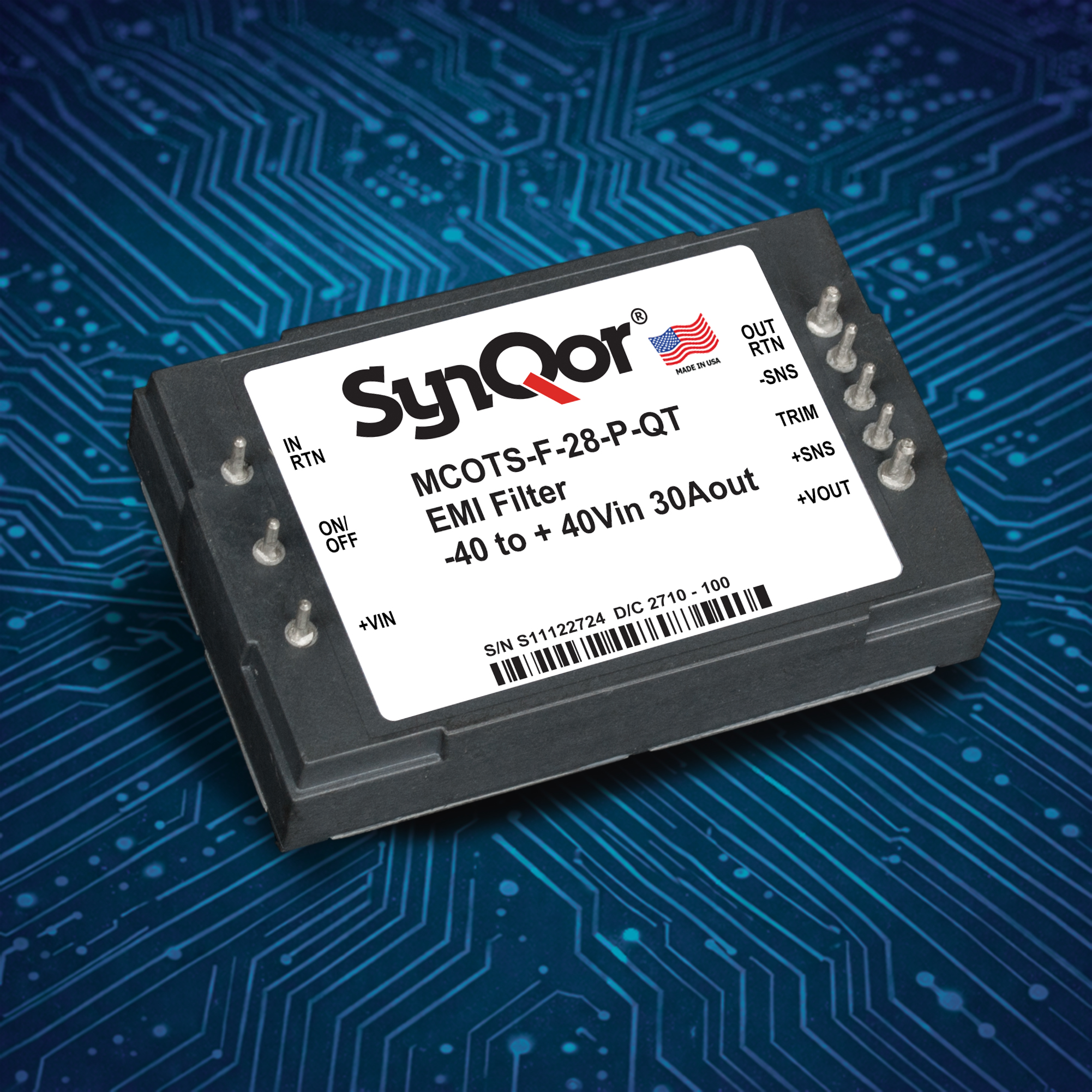
SynQor MCOTS Transient EMI Filter Module

Mil-COTS MCOTS-F-28-T-HE Half-Brick Transient EMI Filter

The MCOTS-F-28-T-HE is a high-efficiency half-brick filter module designed specifically for 28V nominal military DC input lines. It absorbs and clamps severe voltage spikes up to +210V (and reverse polarity down to -60V) while attenuating switching noise to clear MIL-STD-461 (CE101/CE102) and MIL-STD-1275 (Surge/Spike) compliance.

  • 80V Continuous Input
  • 30A Output Current
  • >98% Operating Efficiency
  • MIL-STD-1275 Clamping
Send an Inquiry
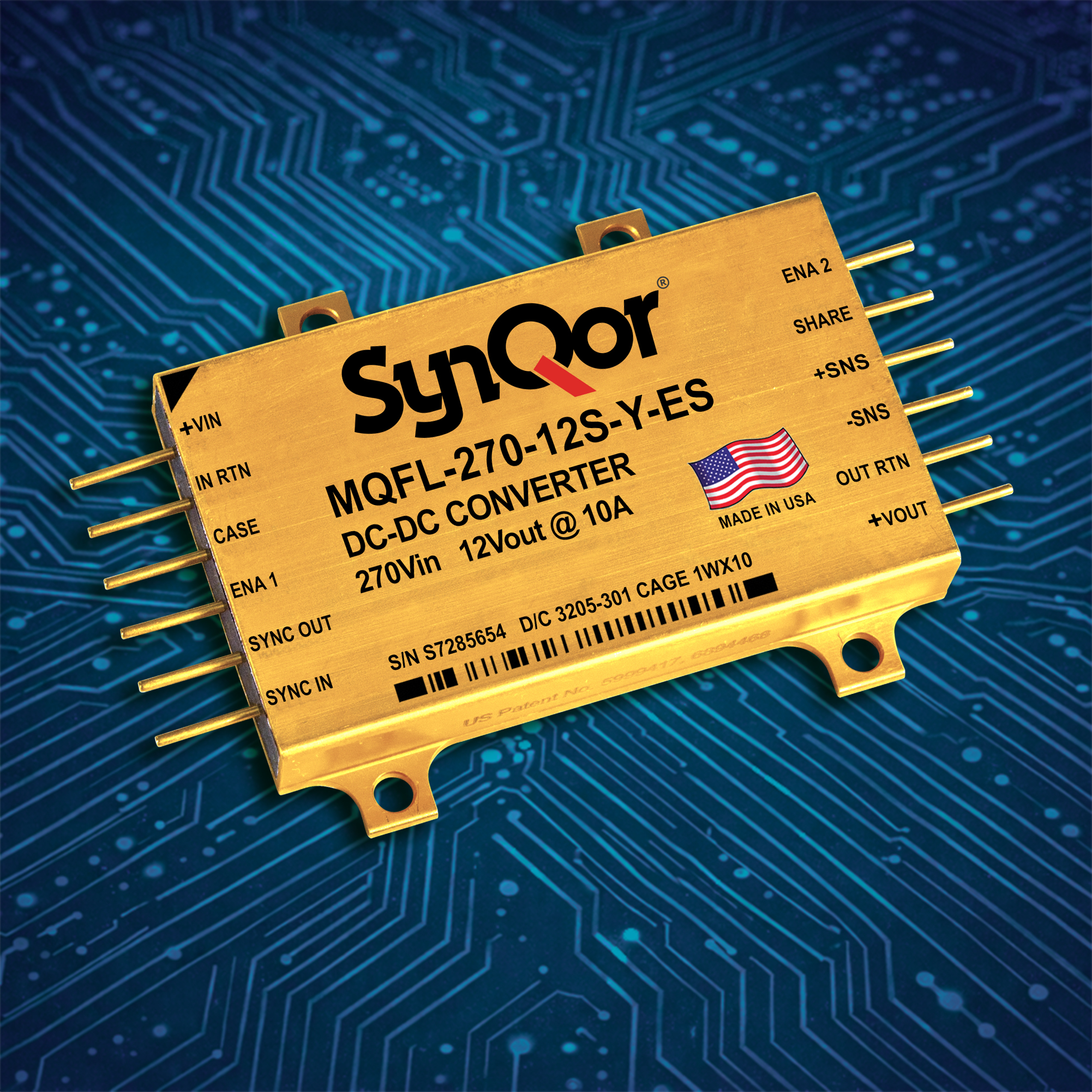
SynQor MilQor Hi-Rel DC-DC Converter with Filter Integration

MilQor® High-Reliability Isolated DC-DC Converter & Filter Chains

Designed for mission-critical military aerospace and defense applications. When combined with SynQor MCOTS filter modules, MilQor isolated half-brick and full-brick converters achieve complete power isolation, tight voltage regulation, and ultra-high efficiency (>95%) across extreme baseplate temperatures (-55°C to +100°C).

  • 16V - 60V Input Range
  • Synchronous Rectification
  • Encapsulated Aluminum Case
  • AS9100 Lot Traceability
Send an Inquiry
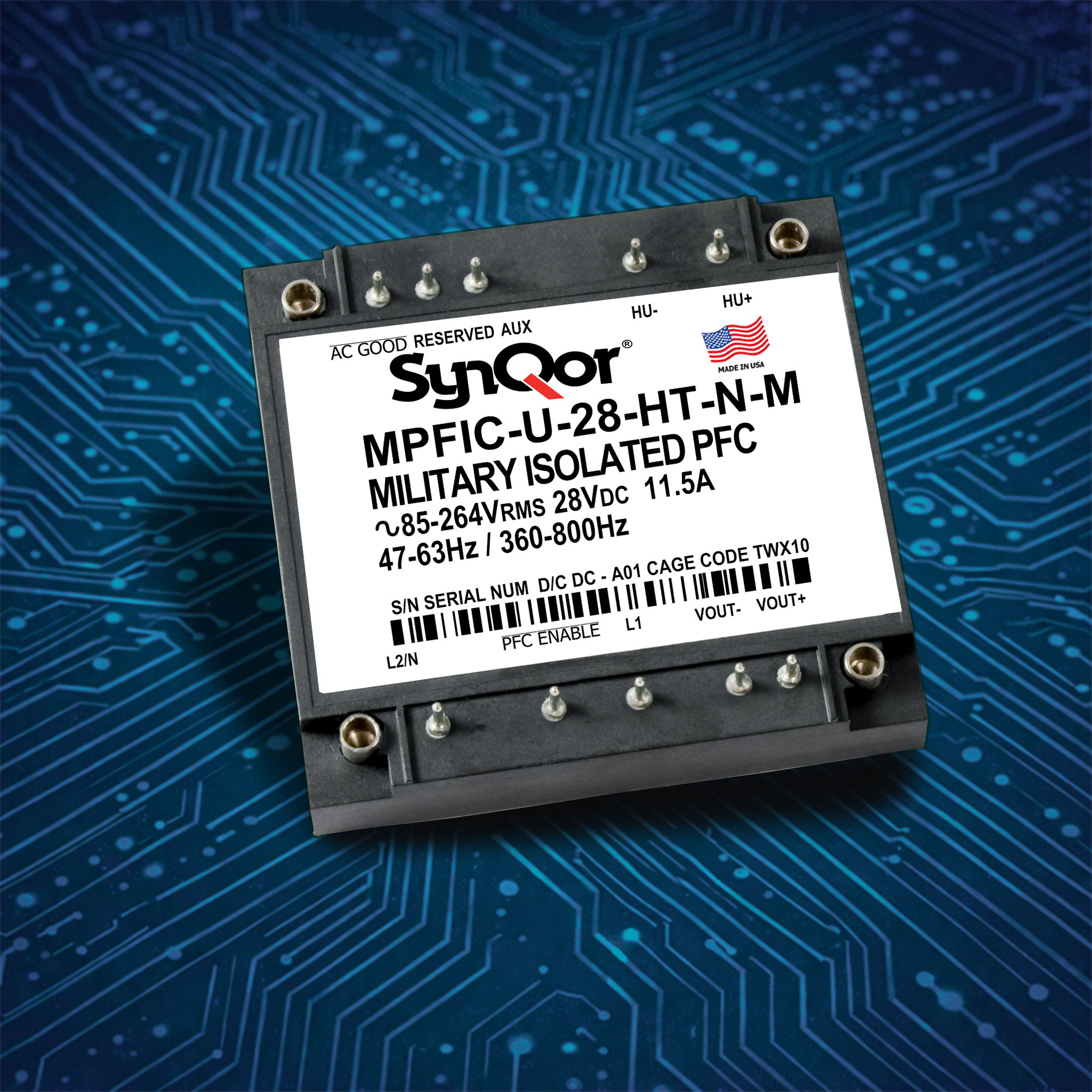
SynQor MPFIC 3-Phase Power Factor Correction & Active EMI Filter Module

MPFIC Military 3-Phase Power Factor Correction & Active EMI Front-End

The MPFIC-115-3PD-28R-FG is a high-power full-brick module delivering active power factor correction and low harmonic distortion for 3-phase 115 Vrms aircraft and naval power systems. It integrates line filtering to satisfy MIL-STD-704, MIL-STD-1399, and RTCA DO-160 airborne conducted limits.

  • 3-Phase 115 Vrms Line-to-Line
  • 0.99 Power Factor
  • 45 Hz - 800 Hz Input
  • DO-160G & MIL-STD-461
Send an Inquiry
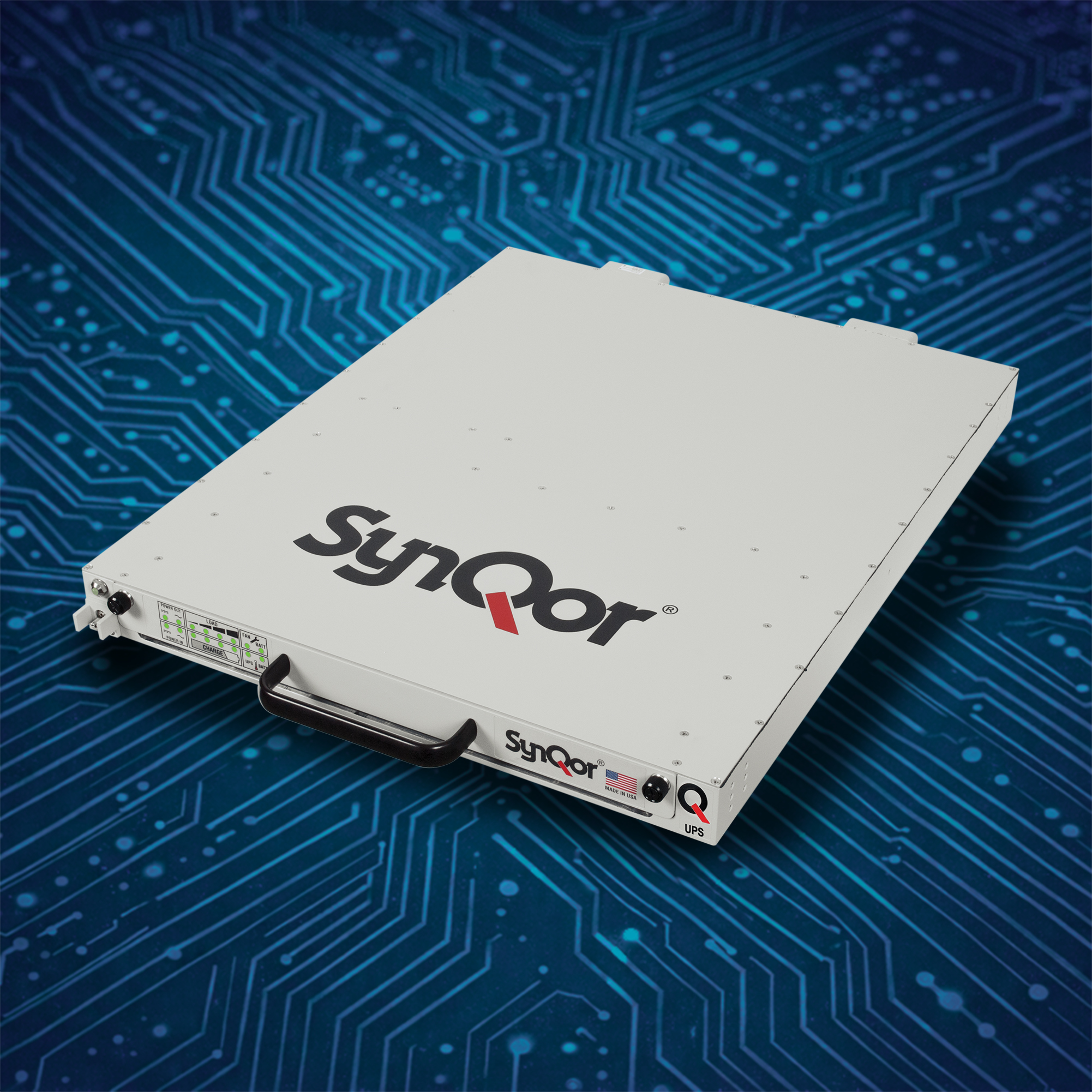
SynQor Military Field-Grade 3-Phase Uninterruptible Power Supply

Military Field-Grade Uninterruptible Power Systems (UPS) with Built-In EMI Filtering

Rugged 1U rack-mount field-grade UPS units built for land vehicle command shelters, naval surface vessels, and mobile radar stations. Features internal military-grade EMI filters, active PFC, dynamic battery management, and compliance with MIL-STD-810G environmental impact profiles.

  • 1250W / 1500VA Power Output
  • Single/3-Phase AC & 28V DC
  • Internal MIL-STD-461 Filter
  • Sealed Conduction Enclosure
Send an Inquiry
Market Intelligence & AI Intent Insights

As global defense prime contractors transition toward autonomous platforms, electro-magnetic spectrum warfare, and high-density wide-bandgap semiconductors, power filter architectures are undergoing fundamental evolution.

1. Transition From Custom Discrete Circuits to High-Density COTS Modules

Historically, defense system integrators custom-designed EMI filter circuits directly onto their system motherboards using discrete inductors, bulk electrolytic capacitors, and transient suppression diodes. However, modern defense procurement timelines no longer tolerate the iteration cycles and re-qualification risks associated with discrete designs. Procuring pre-certified Mil-COTS Military Standard EMI Filter modules allows engineering teams to treat EMI suppression as a plug-and-play building block with guaranteed insertion loss curves, reducing time-to-market and eliminating unexpected EMC test chamber failures.

2. Wide-Bandgap (GaN & SiC) High Switching Frequency Impact

The rapid adoption of Gallium Nitride (GaN) and Silicon Carbide (SiC) power switches has pushed DC-DC converter switching frequencies from traditional 100 kHz – 300 kHz bands up to 1 MHz – 3 MHz+. While wide-bandgap devices dramatically reduce magnetic component size, their extremely high $dv/dt$ and $di/dt$ slew rates generate intense high-frequency common-mode noise harmonics extending into the 100 MHz – 1 GHz range. Future Military Standard EMI Filters are incorporating specialized multi-layer ceramic parasitics, nanocrystalline core magnetic materials, and active noise cancellation (ANC) topologies to maintain high attenuation across ultra-wide frequency bandwidths.

3. Unified Multi-Standard Qualification for Multi-Mission Platforms

Modern defense equipment is increasingly deployed across multiple physical environments — e.g., a tactical communication package might be installed inside a ground combat vehicle (MIL-STD-1275), mounted in a transport aircraft (MIL-STD-704 / DO-160), or deployed on a naval vessel (MIL-STD-1399). Procurement officers are seeking "Universal Defense EMI Filters" that hold unified qualification across all three domain standards, eliminating the need to stock multiple SKU inventory lines for different military branches.

4. SWaP-C (Size, Weight, Power, and Cost) Optimization for UAVs and Tactical Missiles

In airborne systems and unmanned aerial vehicles, every gram of payload weight and every cubic centimeter of enclosed volume impacts operational range. Next-generation Military Standard EMI Filters feature extreme volumetric power density, utilizing planar magnetics, direct-bonded copper (DBC) substrates, and thermally conductive encapsulation resins to achieve maximum current ratings in quarter-brick and half-brick form factors without requiring active fan cooling.

5. Domestic Supply Chain Security & Cyber-Physical Integrity

Global defense organizations and major prime contractors (Lockheed Martin, Raytheon, Northrop Grumman, BAE Systems, General Dynamics) are placing increased emphasis on supply chain integrity, microelectronic provenance, and anti-counterfeit protection. Sourcing power filter modules manufactured entirely within certified U.S. facilities under AS9100 quality management systems protects programs against component obsolescence, counterfeit components, and geopolitical supply disruptions.

Enterprise Strengths

Why Defense OEMs Specify SynQor Military Standard EMI Filters

SynQor’s engineering philosophy combines process control, proprietary topology design, and rigorous testing discipline to ensure multi-decade program success.

Send an Inquiry

25+ Years of Synchronous-Rectifier Innovation

SynQor commercialized synchronous rectification in isolated modules. Our filter designs inherit this low-loss philosophy, keeping insertion loss down and module efficiency above 98%.

100% U.S. Engineering & AS9100 / ISO-9001 Manufacturing

All design, qualification testing, encapsulation, and final screening are performed in Salem, New Hampshire, USA, guaranteeing complete supply-chain traceability and ITAR compliance readiness.

Pre-Characterized Filter & Converter Pairs

We test our EMI filters directly alongside our DC-DC and AC-DC converters as an integrated chain, providing guaranteed MIL-STD-461 CE102 plots and eliminating EMC trial-and-error cycles.

Defense Procurement & Engineering FAQ

Frequently Asked Questions on Military Standard EMI Filters

Mined from top engineering inquiries and AI search prompts asked by defense procurement specialists worldwide.

A Military Standard EMI Filter is engineered specifically to comply with stringent military defense specifications, most notably MIL-STD-461 (for conducted and radiated electromagnetic emissions and susceptibility) and MIL-STD-1275 / MIL-STD-704 (for handling harsh bus voltage surges, spikes, and transients). Commercial EMI filters are designed for benign indoor environments with narrow operating temperatures (0°C to +70°C) and limited over-voltage protection.

In contrast, military filters feature fully potted aluminum baseplate construction for conduction cooling across -55°C to +100°C, extreme shock and vibration immunity under MIL-STD-810G, active internal over-voltage clamping (protecting against +100V 50ms surges and +250V 50µs spikes), and high reliability manufacturing governed by AS9100 aerospace quality standards.

MIL-STD-461 CE102 establishes strict upper limits on conducted emissions returning from equipment power leads to the main bus across the 10 kHz to 10 MHz frequency spectrum. SynQor military EMI filters utilize multi-stage differential-mode and common-mode passive LC networks optimized with high-permeability magnetic cores.

To address CS101 (conducted susceptibility, where ripple voltage is injected onto the power line), SynQor filters incorporate active attenuation and tuned RC damping networks. When paired with SynQor’s high-efficiency isolated DC-DC converters, the combined filter-converter chain prevents input ripple from disturbing output regulation, clearing both CE102 and CS101 tests on the first pass.

No single filter topology covers both DC and AC power architectures efficiently due to fundamental differences in line frequencies, dielectric voltage isolation ratings, and safety leakage current limits. SynQor provides distinct, dedicated product families for each input standard:

  • MCOTS Filter Series: Optimized for 28V, 48V, and 270V DC input buses found in ground tactical vehicles (MIL-STD-1275) and military aircraft DC systems (MIL-STD-704).
  • MPFIC & AeroQor Series: Designed for single-phase and 3-phase 115V/230V AC lines operating at 400 Hz or wide variable frequencies (360 Hz - 800 Hz) compliant with RTCA DO-160G and MIL-STD-1399.

Regulated switch-mode DC-DC converters act as constant-power loads, exhibiting negative dynamic input impedance ($Z_{iC} = -\frac{V_{in}^2}{P_{out}}$). When a passive EMI filter is connected ahead of the converter, the filter's output impedance ($Z_{oF}$) can form a resonant tank circuit with the converter’s input capacitance.

If $|Z_{oF}|$ approaches or exceeds $|Z_{iC}|$, severe phase margin loss occurs, triggering voltage oscillations and system instability (Middlebrook's stability criterion). SynQor designs its Military Standard EMI Filters with integrated series and parallel RC damping networks. This keeps $|Z_{oF}|$ low and flat across the entire frequency range, guaranteeing stable operation regardless of load or input voltage variations.

Defense electronics are frequently housed in sealed, fanless IP67/NEMA-6 enclosures or ARINC cold-wall chassis to survive dust, moisture, and high-altitude low-pressure environments. SynQor EMI filters are manufactured using thermally conductive potting compounds housed inside nickel-plated aluminum cases with integrated baseplates.

Heat generated by filter winding resistance and transient clamping diodes is transferred directly via conduction through the baseplate to an external cold plate or aluminum chassis wall. This conduction-cooling design enables full power delivery at baseplate operating temperatures up to 100°C without requiring forced air movement.

SynQor maintains an AS9100 and ISO-9001 certified quality management system at its manufacturing headquarters in Salem, New Hampshire, USA. For defense prime contractors and system integrators, SynQor provides comprehensive qualification packages including:

  • MIL-STD-810G Environmental Qualification Data (thermal shock, vibration, humidity, altitude, salt fog).
  • MIL-STD-461 & MIL-STD-1275 Test Reports with actual conducted emissions baseline plots.
  • Component Stress & Derating Analysis based on NAVSEA TE000-AB-GPG-010 / MIL-HDBK-1547.
  • MTBF Reliability Calculations in accordance with MIL-HDBK-217F (Ground Benign, Ground Mobile, Airborne Inhabited).
  • Certificate of Conformance (CoC), full lot traceability, and anti-counterfeit component documentation.

Ready to Integrate Military Standard EMI Filters into Your Platform?

Consult directly with SynQor application engineers. Send us your system line voltages, continuous load profiles, target standard specs (MIL-STD-461 / 1275 / 704 / DO-160), and mechanical constraints for tailored power architecture support.

Send an Inquiry Contact Engineering Team