Explore our top-tier uninterruptible power supplies engineered for extreme ambient temperatures, high shock/vibration, corrosive salt fog, and mission-critical field operations across Germany.
An engineering analysis of how Germany's Energiewende, Industry 4.0 digitisation, and stringent DIN EN regulatory standards drive demand for ruggedized field UPS architecture.
Germany stands as Europe’s premier industrial power house, driven by advanced manufacturing (Maschinenbau), automotive engineering in Baden-Württemberg and Bavaria, extensive electrified rail transport managed by Deutsche Bahn, and a rapidly expanding renewable energy grid in the North and Baltic Seas. However, operating critical electronic infrastructure outdoors in Germany presents unique power quality and environmental challenges. Conventional commercial rack-mount UPS units fail when subjected to ambient temperature swings from Alpine freezing winters to humid summer heatwaves, ambient dust in heavy industrial manufacturing zones, or corrosive salt spray off Northern German coastal wind farms.
As Germany transitions toward a decentralized energy landscape relying heavily on wind, solar, and local microgrids, grid frequency shifts and micro-interruptions have increased across medium-voltage sub-distribution networks. Outdoor field UPS units act as the primary defense line for smart grid remote terminal units (RTUs), SCADA monitoring stations, and distribution automation switches. Modern German grid operators demand Field UPS systems with active Power Factor Correction (PFC compliant with EN 61000-3-2), low Total Harmonic Distortion (THD < 3%), and seamless integration with Lithium Iron Phosphate ($\text{LiFePO}_4$) battery chemistries capable of delivering 10+ year operational lifespans without thermal runaway risks.
The convergence of physical factory machinery with Industrial Internet of Things (IIoT) architectures across manufacturing hubs like Stuttgart, Munich, Nuremberg, and the Ruhr Valley requires continuous, clean AC power. Smart sensor arrays, edge gateway servers, robotic cells, and automated guided vehicles (AGVs) cannot tolerate a single cycle of outage. Field UPS equipment installed on factory floors or peripheral field enclosures must possess extreme electromagnetic immunity (MIL-STD-461 / EN 61000-6-2 certified) to prevent false triggering from high-voltage arc welders, heavy electric motors, and variable frequency drives (VFDs).
Legacy Valve-Regulated Lead-Acid (VRLA) batteries suffer severe capacity degradation when exposed to temperatures above 25°C or below 0°C—a frequent occurrence in unconditioned outdoor cabinets throughout Germany. German industrial procurement teams are systematically replacing lead-acid systems with advanced Lithium Iron Phosphate ($\text{LiFePO}_4$) battery back-ups equipped with intelligent Battery Management Systems (BMS). LiFePO4 cells provide 3,000 to 5,000 charge cycles, support fast recharging within 60 minutes, and operate reliably across extreme operational windows (-40°C to +75°C), dramatically reducing Total Cost of Ownership (TCO) and field maintenance site visits.
Engineered to excel where standard commercial UPS power supplies fail. Discover tailored applications across key German industrial sectors.
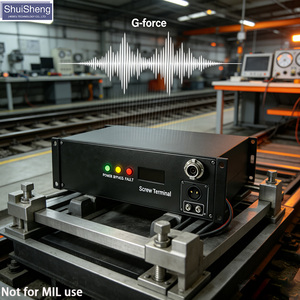
Qualified against EN 50155 and EN 50121-3-2 standards for railway rolling stock and trackside signaling cabinets. Withstands continuous structural vibration, mechanical shock from high-speed trains, and wide catenary voltage variations while maintaining uninterrupted DC/AC backup power for interlocking systems and GSM-R communications.
Specially treated with ISO 12944 C5-M marine anti-corrosion coatings and conformal-coated PCB assemblies. Installed inside wind turbine nacelles and offshore converter platforms to back up pitch control motors, flight warning lights, and safety telemetry during extreme coastal storms.
Provides zero-transfer-time (<0ms) online double-conversion power security for PLC controllers, robotic welding cells, and automated paint lines in major automotive plants in Bavaria and Lower Saxony, preventing multi-million euro losses caused by voltage sags.
Compact pole-mountable and wall-mountable IP67 sealed field UPS enclosures configured for remote 5G small cells, optical node distribution boxes, and traffic control units deployed along Autobahn transport corridors.
Ensures 24/7 power resilience for municipal water treatment plants, tunnel ventilation control boxes, and emergency services communication nodes across major German metropolitan areas including Berlin, Hamburg, and Frankfurt.
Engineered to withstand rigorous military requirements including MIL-STD-810G (environmental engineering), MIL-STD-461 (EMC), and MIL-STD-1275 (transients in 28V DC vehicle power supply), providing tactical communications redundancy in field deployments.
Built on a quarter-century of pioneering power conversion topologies, rigorous quality standards, and unyielding field reliability.
By replacing lossy silicon diodes with actively driven MOSFETs in a two-stage isolated power topology, our conversion technology eliminates fixed forward voltage drops. This cuts internal power dissipation by up to 50%, enabling sealed fanless IP67/IP68 enclosures that withstand ambient operating heat without derating.
Every field UPS module and integrated system is designed, qualified, and manufactured in state-of-the-art facilities under strict process controls. Full component-level serial traceability and archived qualification data guarantee that units delivered in decade ten behave identically to those qualified in year one.
German infrastructure and rail contracts span 20 to 30 years. We protect long-life programs against component obsolescence by maintaining drop-in Form-Fit-Function replacement strategies and direct engineering derating support for system designers.
Side-by-side technical comparison detailing why commercial off-the-shelf UPS units fail in demanding German field installations.
| Performance Parameter | Industrial Field UPS (Our Architecture) | Standard Commercial UPS | Engineering Impact |
|---|---|---|---|
| Ingress Protection (IP) | IP65 / IP67 / IP68 Sealed Enclosure | IP20 / Open Vented Case | Prevents moisture, dust, salt fog, and insect intrusion from shorting internal circuitry. |
| Operating Temperature | -40°C to +75°C (Full Power) | 0°C to +40°C (Derates rapidly above 25°C) | Guarantees continuous uptime during German freezing winters and unconditioned summer heat. |
| Conversion Efficiency | Up to 96% (Synchronous Rectification) | 85% - 90% (Legacy Diode Topology) | Dramatically reduces internal heat generation; eliminates reliance on failure-prone cooling fans. |
| Battery Chemistry & Life | LiFePO4 with BMS (10+ Year Life / 4000 Cycles) | Standard VRLA Lead-Acid (2-3 Year Life) | Cuts maintenance site visits by 75%; eliminates field battery swelling and thermal runaway. |
| Vibration & Shock Rating | MIL-STD-810G & EN 50155 Compliant | Non-Rated / Office Stationary Only | Resists mechanical fatigue on railway lines, wind turbine towers, and mobile vehicle rigs. |
| Standards Compliance | DIN EN 62040, VDE 0100, EN 50155, CE | Basic CE / UL 1778 Office Standards | Ensures full compliance with German industrial electrical codes and audit requirements. |
Detailed technical answers to common questions regarding standards compliance, customization, lead times, and thermal performance in Germany.
Our industrial Field UPS systems are fully engineered to meet and exceed DIN EN 62040-1 (General and safety requirements), DIN EN 62040-2 (EMC requirements Category C1/C2), and DIN EN 62040-3 (Method of specifying performance and test requirements). Furthermore, all AC distribution interfaces adhere to DIN VDE 0100 electrical installation directives, incorporating galvanically isolated output transformers and active Power Factor Correction (PFC > 0.99) to protect the surrounding German distribution grid from harmonic pollution.
Unlike commercial indoor UPS units that shut down when ambient temperatures drop below 0°C or exceed 40°C, our ruggedized Field UPS platforms utilize wide-temperature military-grade components and custom aluminum conduction plates. Coupled with advanced Lithium Iron Phosphate ($\text{LiFePO}_4$) battery packs equipped with integrated internal thermal management heaters, our UPS systems maintain 100% rated power output across extreme temperature ranges from -40°C up to +75°C.
Yes. Every field-grade UPS unit comes equipped with flexible communication cards supporting standard European industrial protocols including Modbus TCP/RTU, SNMP v3, and PROFINET interface options. This enables seamless telemetry integration into Siemens SIMATIC S7 PLCs, SCADA control systems, and centralized remote monitoring dashboards used across German automated factories.
We maintain streamlined logistic channels and stock dedicated standard modular chassis for quick dispatch across Germany (including major industrial centers such as Frankfurt, Munich, Hamburg, and Stuttgart). Standard units can be delivered within short turnaround windows, while customized OEM configurations undergo fast-track qualification testing under our AS9100D quality management system.
In fanless sealed enclosures (IP65, IP67, or IP68), heat dissipation is the primary factor limiting system life. Traditional power supply topologies use Schottky diodes that drop roughly 0.5V to 0.7V, dissipating significant energy as waste heat. Synchronous Rectification replaces these diodes with high-efficiency MOSFETs having ultra-low $R_{DS(on)}$, cutting conduction losses by up to 50%. This high efficiency (>96%) keeps internal temperatures low enough to rely solely on natural convection or baseplate conduction cooling—eliminating fan maintenance completely.
Consult with our senior application engineers to review your voltage bus specifications, ambient environmental constraints, DIN standards, and battery autonomy requirements before committing to hardware layout.
Get Catalog