Railway operators are demanding longer service intervals, safer electronics, and stable performance across increasingly digital fleets. The UNIFE World Rail Market Study 2024 estimates the global rail supply market at approximately €201 billion annually, with continued growth expected through 2027. This expansion increases pressure on every onboard subsystem, including auxiliary power conversion. EN 50155 Railway DC-DC Converters support this demand by addressing railway-specific temperature, vibration, humidity, EMC, insulation, and voltage requirements. The standard is not a marketing badge. It is a practical engineering baseline.
Professor Clive Roberts, a recognised railway systems specialist, often describes railways as “a system of systems.” That view matters inside a converter cabinet. A converter must cooperate with traction equipment, signalling circuits, batteries, sensors, and passenger-information networks. One unstable output can create a surprisingly large operational problem. No converter is magic. Poor wiring, inadequate cooling, or weak maintenance can still defeat compliant equipment. That point deserves more attention.
Data from the International Energy Agency also highlights rail’s importance as an energy-efficient transport mode, increasing the value of dependable onboard power management. In service, reliability appears in small details: clean 24 V outputs, secure terminal blocks, diagnostic LEDs, and predictable restart behaviour after voltage dips. EN 50155 Railway DC-DC Converters help engineers design for those realities. However, buyers should examine test evidence, derating curves, isolation performance, warranty terms, and field experience. Compliance alone is useful, but it is not the whole decision.
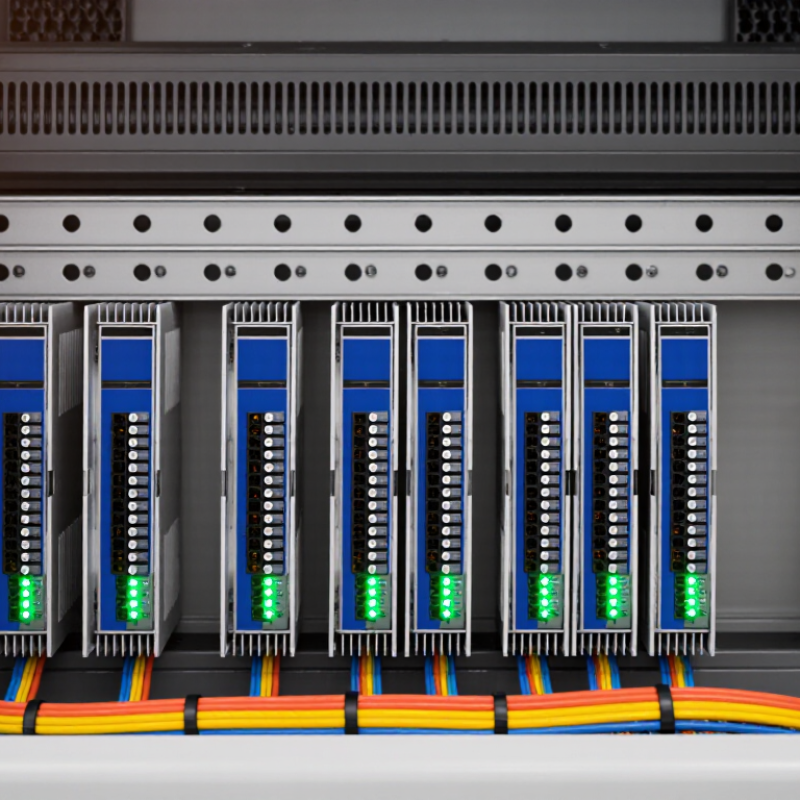
Railway DC-DC converters transform unstable onboard DC power into controlled voltages for critical electronics. They commonly supply traction control, signaling, communication, passenger information, and monitoring equipment. The input may face surges, voltage dips, electrical noise, and rapid load changes. The converter must keep working.
Its core functions are practical. It regulates voltage for sensitive circuits. It provides galvanic isolation between input and output. It also limits current, manages short circuits, filters interference, and controls thermal stress. Some designs include hold-up capacity, keeping equipment alive during brief supply interruptions. Small details matter here. A loose terminal or poor grounding path can defeat an excellent circuit.
EN 50155 defines demanding requirements for railway electronic equipment, including temperature, vibration, humidity, electrical disturbance, and reliability testing. The 2024 UNIFE World Rail Market Study forecasts approximately 3% annual growth in the global rail supply market through 2029, increasing pressure for dependable onboard electronics. The International Energy Agency also identifies rail as one of the most energy-efficient transport modes, which strengthens interest in efficient auxiliary power systems.
Efficiency alone is not enough. A converter may perform well in laboratory tests, yet behave differently beside traction inverters and long cable runs. Field engineers should verify isolation, derating, EMC performance, and maintenance access under real operating conditions. Mistakes remain possible, especially when designers underestimate temperature cycling.
Why Choose EN 50155 Railway DC DC Converters?
EN 50155 requirements define how railway power conversion systems must behave in harsh service. A converter may face wide input variation, brief interruptions, electrical transients, vibration, humidity, and rapid temperature changes. It must also maintain safe insulation and controlled output voltage. The exact test level depends on the installation category and operating environment. A cabinet converter and an underfloor converter should not share identical assumptions.
The International Energy Agency’s The Future of Rail report states that rail carries about 8% of global passengers and 7% of freight, while using only 2% of transport energy. This efficiency increases the importance of dependable onboard electronics. EN 50155 compliance should be evaluated with related standards, including EN 50121-3-2 for EMC and EN 61373 for shock and vibration. In practice, engineers should review startup behavior, load steps, cooling airflow, and connector retention. A laboratory pass is valuable, but field conditions remain less tidy.
Tips: Request complete test evidence, not only a compliance label. Check input interruption performance with the real battery profile. Measure the converter beside its wiring, fuse, and load. One overlooked cable can weaken an otherwise strong design. Periodic thermal checks also help reveal blocked airflow or aging components. Mistakes happen. Careful review reduces their cost.
| Requirement Area | EN 50155 Requirement or Classification | Typical Requirement for a Railway DC-DC Converter | Design Significance |
|---|---|---|---|
| Scope of Application | Electronic equipment installed on railway rolling stock | Suitable for control, communication, signaling-support, monitoring, and auxiliary power equipment | Ensures the converter is designed for the operating conditions found on rolling stock rather than for general industrial use only |
| Nominal Supply Voltage | The converter must be matched to the applicable railway auxiliary supply system | Common railway input systems include 24 V, 36 V, 48 V, 72 V, 96 V, 110 V, and 220 V DC, depending on the vehicle architecture | Correct voltage selection prevents undervoltage shutdown, excessive input current, and insulation stress |
| Input Voltage Variation | EN 50155 defines supply-voltage operating conditions and test categories for rolling-stock electronic equipment | The input range must be specified for the selected nominal voltage and vehicle supply class; a frequently used design range is approximately 0.7 to 1.25 times nominal voltage | A wide and clearly verified input range helps maintain regulated output during battery variation and auxiliary-bus disturbances |
| Supply Interruptions | The standard includes defined interruption tests associated with the relevant supply class | The power converter may need to ride through short interruptions without damaging components, losing regulation, or causing uncontrolled restart | Hold-up capacitance, controlled restart, input protection, and power-management firmware improve system continuity |
| Operating Temperature | EN 50155 temperature classes include OT1, OT2, OT3, OT4, OT5, and OT6 | Depending on the selected class, operating ranges extend from −25 °C or −40 °C at the low end to +55 °C, +70 °C, or +85 °C at the high end | Thermal derating, component selection, enclosure design, and cooling must be validated across the complete declared range |
| Temperature Change and Thermal Shock | Equipment is evaluated for temperature variation and environmental transition effects | The converter should tolerate repeated changes between low and high operating temperatures without cracking, condensation-related failure, or output instability | Robust PCB construction, conformal protection where appropriate, and controlled thermal expansion improve field reliability |
| Humidity | Humidity and damp-heat tests are part of the environmental qualification framework | The converter should maintain insulation performance, dielectric strength, and stable output under high-humidity conditions | Moisture-resistant materials and suitable creepage and clearance distances reduce leakage and corrosion risks |
| Altitude and Atmospheric Pressure | The applicable equipment specification must consider installation altitude and reduced air density | Insulation coordination, cooling performance, and any clearance requirements should be checked for the intended operating altitude | Reduced convection and lower dielectric strength can affect both thermal margins and insulation reliability |
| Mechanical Vibration and Shock | Railway rolling-stock equipment is exposed to vibration and shock profiles defined by the applicable railway environmental standards | The converter should withstand vibration, mechanical shock, connector movement, and component fatigue during service | Secure mounting, reinforced solder joints, locking connectors, and vibration-resistant magnetics are important for long service life |
| Electromagnetic Compatibility | EN 50155 is used together with the applicable railway EMC requirements, commonly including EN 50121-3-2 for rolling-stock apparatus | The converter should control conducted emissions, radiated emissions, electrostatic discharge, fast transients, surges, and immunity disturbances | EMC filtering, shielding, grounding, PCB layout, and transient protection help prevent interference with onboard systems |
| Electrical Safety and Insulation | Insulation, dielectric-strength, creepage, clearance, and protective-earthing requirements depend on the equipment architecture and installation | The DC-DC converter should provide verified input-to-output isolation where required and maintain safe separation under normal and fault conditions | Proper isolation protects passengers, maintenance personnel, connected electronics, and vehicle wiring |
| Fire and Smoke Considerations | Railway vehicle fire-protection requirements are generally addressed through the applicable EN 45545-2 hazard-level and material requirements | Enclosures, plastics, cables, and insulating materials may require suitable fire, smoke, and toxicity performance for the vehicle installation | Material selection supports passenger safety and limits the consequences of an onboard fire |
| Reliability and Maintainability | The required reliability, availability, maintainability, and safety targets are determined by the project and system-level specifications | Recommended features include current limiting, short-circuit protection, overtemperature protection, input reverse-polarity protection, and diagnostic indication | Protection and diagnostics reduce service interruptions and simplify troubleshooting in difficult operating environments |
| Output Regulation and Power Quality | Output performance is normally defined by the equipment specification and the requirements of the connected load | Key parameters include output-voltage accuracy, ripple, transient response, load regulation, efficiency, and permissible overload duration | Stable and low-noise power improves the performance of sensors, communication equipment, control units, and digital electronics |
| Verification and Documentation | Compliance depends on documented testing against the applicable clauses, environmental classes, and related railway standards | A complete technical file should identify the rated input, output, temperature class, supply class, test conditions, limitations, and installation requirements | Traceable documentation makes system integration, acceptance testing, maintenance, and future audits more efficient |
Note: The exact acceptance criteria depend on the applicable edition of EN 50155, the selected temperature and supply classes, the vehicle installation, and related railway standards. A project-specific compliance assessment should be completed before final equipment selection.
Railway power systems face vibration, dust, humidity, and rapid voltage changes. EN 50155 addresses these operating conditions for electronic equipment used on rolling stock. A compliant DC-DC converter can support stable auxiliary power for control units, communication devices, sensors, and passenger information systems. That stability matters when a train enters a tunnel or switches operating modes.
UNIFE’s World Rail Market Study 2024 estimates the global rail supply market at €201.9 billion annually from 2019 to 2023. It forecasts approximately €240.8 billion annually for 2023 to 2027. This expansion increases demand for compact, serviceable, and dependable power electronics. EN 50155 testing typically considers temperature, humidity, shock, vibration, supply interruptions, and electromagnetic compatibility. These checks help engineers compare converter performance under realistic railway stresses.
But compliance is not a magic shield. System designers must still verify grounding, thermal paths, input protection, and enclosure layout. A converter may pass laboratory tests yet perform poorly after incorrect installation. The European Union Agency for Railways continues to emphasize safe, reliable, and interoperable railway systems in its safety reporting. That wider requirement deserves attention. Engineers should review the converter’s test evidence, derating curves, and maintenance history before approval. Small details matter.
Why Choose EN 50155 Railway DC DC Converters?
How These Converters Operate in Railway Environments
Railway power systems rarely provide perfectly stable voltage. Voltage can dip during traction changes or rise during regenerative braking. An EN 50155 railway DC DC converter manages these variations for sensitive onboard electronics. It accepts a defined input range and delivers regulated power to control units, sensors, communication devices, and lighting systems.
The track is unforgiving. Vibration, dust, humidity, and rapid temperature changes affect daily operation. Therefore, the converter needs a rugged enclosure, secure connections, and suitable thermal management. Electrical isolation also helps separate the input circuit from the output circuit. This reduces interference and improves protection for connected equipment.
During operation, internal switching circuits transfer energy through magnetic components. Feedback controls continuously adjust the output voltage as the load changes. Protection functions respond to overloads, short circuits, overheating, and abnormal input conditions. Engineers usually verify these behaviors through testing under vibration, temperature cycling, electrical transients, and electromagnetic compatibility conditions.
Field experience shows that installation still matters. Poor airflow or loose terminals can undermine a well-tested design. That assumption can fail. Regular inspection should check connector tension, cooling paths, and unusual temperature increases. No converter is maintenance-free, and railway conditions can expose small weaknesses over time. Proper selection, testing, and installation help maintain stable power throughout long service periods.
Railway DC-DC converters must maintain stable, isolated power while facing wide temperature changes, electrical transients, vibration, and limited maintenance access. EN 50155 temperature classes define operating ranges from −40°C to +85°C, helping engineers select equipment suited to the installation environment. Inside the converter, input filtering reduces disturbances, a high-frequency switching stage transfers energy through isolation, and closed-loop regulation maintains a stable output for control, signaling, communication, and onboard electronic systems.
The temperature bands shown are EN 50155 operating temperature classes. Final converter selection also depends on input voltage, load profile, insulation, EMC, vibration, and protection requirements.
Selecting a railway DC-DC converter starts with the vehicle’s electrical environment. EN 50155 defines requirements for electronic equipment used on rolling stock. Check the input range, not only the nominal battery voltage. A 110 V system can experience dips, surges, and switching disturbances. The converter should tolerate these conditions without resetting connected controls. Review the required temperature class, humidity exposure, vibration, shock, and altitude. Installation location matters greatly. An underfloor enclosure faces harsher conditions than an equipment cabinet.
Output performance deserves equal attention. Confirm continuous power, peak demand, startup behavior, and output ripple. A converter rated at its limit may overheat during repeated door cycles or auxiliary motor starts. Leave practical thermal margin. It helps. Galvanic isolation, insulation coordination, and protective functions should match the system architecture. Verify short-circuit behavior, overload recovery, and electromagnetic compatibility evidence through documented test results. Datasheets alone can hide important limitations.
Maintenance teams also need clear diagnostics and accessible connections. Look for alarm contacts, remote enable control, measured efficiency, and serviceable mounting. Cable length and grounding arrangements can change EMC performance in the finished vehicle. That detail is often underestimated. From field evaluations, conservative derating usually improves reliability, although excessive derating increases size and cost. No checklist is perfect. Review the converter against the actual train duty cycle, then confirm compliance with the project’s applicable railway standards and safety process.
It changes unstable onboard DC power into controlled voltage for railway electronics. It can supply signaling, communication, monitoring, and passenger information systems. It must tolerate surges, voltage dips, noise, and sudden load changes.
Galvanic isolation separates the input and output electrical circuits. It helps protect sensitive equipment from noise and ground-related disturbances. It also supports safer system design when different circuits use separate reference potentials.
Railway converters may face vibration, shock, humidity, temperature cycling, and electrical transients. Installation location changes the stress level. An underfloor enclosure usually needs stronger environmental protection than an indoor cabinet.
EN 50155 defines requirements for electronic equipment used on rolling stock. Engineers should check temperature class, input interruptions, insulation, vibration, and reliability evidence. A compliance label alone may not reveal every limitation.
Review the full input range, not only the nominal battery voltage. Check continuous power, peak demand, startup behavior, ripple, and overload recovery. A converter operating at its limit may overheat during repeated motor starts.
EMC performance depends on the converter, wiring, grounding, fuse, and connected load. Test the complete installation when possible. Long cables can change results. Small details matter.
Useful functions include current limiting, short-circuit protection, thermal management, and controlled overload recovery. Some converters provide hold-up capacity during brief supply interruptions. This can prevent connected equipment from resetting.
Choose accessible mounting, clear diagnostics, alarm contacts, and remote enable control. Inspect airflow paths and connections during service visits. Periodic thermal checks can reveal blocked cooling or aging components.
No. Laboratory testing is important, but field conditions are less tidy. Engineers should verify performance beside traction equipment, real wiring, and actual load cycles. Mistakes happen. Conservative derating often helps, although excessive derating increases size and cost.
EN 50155 Railway DC-DC Converters are specialized power conversion devices designed to provide stable, reliable, and isolated DC power for railway equipment. They convert fluctuating input voltages from onboard power systems into regulated outputs suitable for control units, communication systems, sensors, lighting, and other electronic devices. Their design addresses the demanding requirements of railway applications, including wide input voltage ranges, electrical noise, vibration, shock, temperature variation, humidity, and continuous operation.
The main advantages of EN 50155-compliant converters include improved system reliability, enhanced electrical protection, efficient energy conversion, and long service life. In railway environments, these converters help maintain consistent performance during starting, braking, and changes in the onboard power supply. When selecting a suitable converter, engineers should consider input and output voltage, power capacity, isolation, efficiency, cooling method, environmental conditions, installation space, protection functions, and compliance with relevant railway standards. These factors ensure dependable operation and support the safety and stability of modern railway systems.
