Selecting the 2026 top RTCA DO-160 Airborne AC-DC Converters requires more than comparing voltage ratings or catalog prices. Aircraft power systems face narrow installation spaces, unstable electrical conditions, vibration, humidity, and rapid temperature changes. A reliable converter must transform aircraft AC power into clean, regulated DC power without disturbing nearby avionics.
This guide examines converter performance through practical engineering criteria. It considers input frequency tolerance, output stability, efficiency, thermal behavior, electromagnetic compatibility, and protection against transients. DO-160 testing provides an important framework. However, compliance claims should be checked against current test reports, qualification records, and installation conditions. Labels can mislead.
The strongest candidates should demonstrate consistent operation during altitude changes, conducted susceptibility tests, and vibration exposure. Their housings should support dependable heat transfer inside crowded equipment bays. Clear derating curves matter, especially when ambient temperature rises near the aircraft skin. Service history also deserves attention, because laboratory success does not guarantee field reliability.
There is no universal winner. A compact converter may save weight but sacrifice cooling margin. A highly efficient unit may still require careful grounding. These trade-offs are easy to overlook. This overview compares leading options using documented evidence, engineering judgment, and realistic airborne application needs. Some conclusions may change as manufacturers update qualification data. That uncertainty should remain visible.
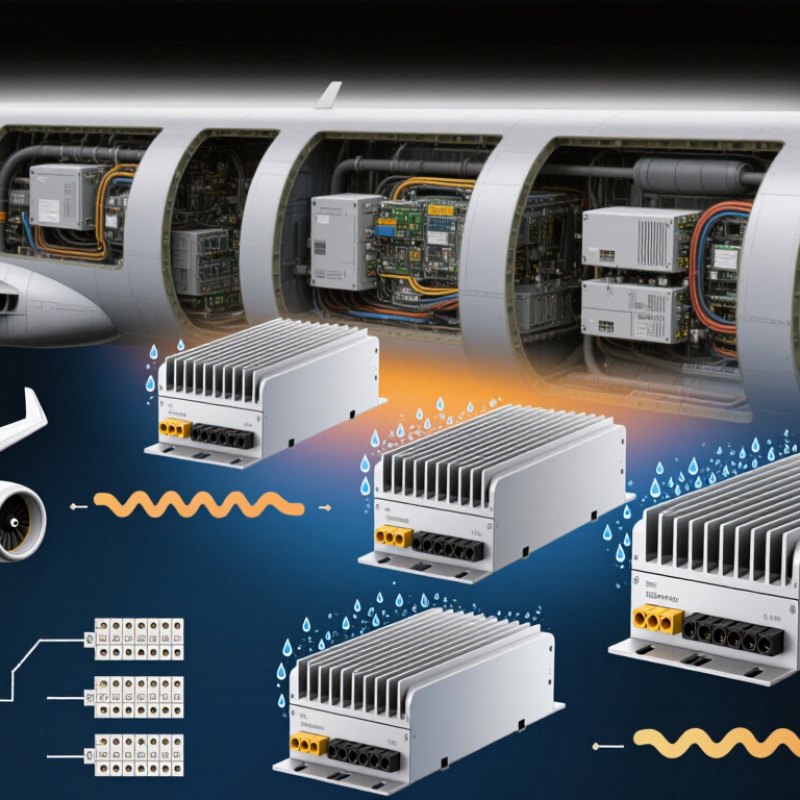
RTCA DO-160 Requirements for Airborne AC-DC Converters
Airborne AC-DC converters must survive more than normal voltage conversion. RTCA DO-160 evaluates environmental and electrical performance under defined aircraft conditions. The test plan may include temperature, altitude, humidity, vibration, shock, and waterproofness. It can also address conducted emissions, radiated susceptibility, lightning-induced transients, and power input disturbances.
A reliable converter should match its installation category and aircraft power system. For example, a 115 VAC, 400 Hz input needs stable output during frequency variation and short interruptions. Engineers should check inrush current, output ripple, hold-up time, thermal rise, and load response. Test evidence must connect each requirement with measured results, calibrated equipment, and clear configuration records. Passing one test does not prove universal suitability. That assumption is risky.
Tips: Define the DO-160 sections before selecting hardware. Test with realistic cable lengths, mounting methods, cooling limits, and worst-case loads. Inspect connectors after vibration testing. Review margins, not only pass or fail results. A clean laboratory result may change after installation. This is where careful engineering judgment matters.
RTCA DO-160 Requirements and Typical Selection Data for Airborne AC-DC Converter Applications
| Converter Category | Typical Aircraft AC Input | Typical DC Output | Typical Power Range | Typical Efficiency | Primary Aircraft Use | Key DO-160 Evaluation Areas | Selection Priority |
|---|---|---|---|---|---|---|---|
| Low-Power Avionics AC-DC Converter | 115/200 V AC, 360–800 Hz | 28 V DC | 50–150 W | Typically 85–92% | Communication, navigation, display and sensor electronics | Sections 4–8, 15–22, 24–26; conducted emissions and susceptibility are normally important for avionics bays | Low noise, small size and stable 28 V DC regulation |
| 28 V DC Aircraft-Service Converter | 115/200 V AC, 360–800 Hz | 28 V DC nominal | 150–500 W | Typically 88–94% | Cabin systems, utility loads, instrumentation and control units | Sections 4, 5, 7, 8, 15, 16, 17, 18, 20, 21, 22 and 25 | Input-transient tolerance, thermal margin and maintainability |
| High-Power 28 V DC Converter | 115/200 V AC, 360–800 Hz | 28 V DC nominal | 500 W–2 kW | Typically 90–96% | Actuators, motor-control electronics, pumps and mission equipment | Sections 4, 8, 15–23, 25 and 26; cooling, harmonics and transient behavior require system-level review | Power density, cooling method, overload capability and electromagnetic compatibility |
| Dual-Output Avionics Converter | 115/200 V AC, 360–800 Hz | 28 V DC plus 5 V, 12 V or 15 V DC | 100–600 W | Typically 86–94% | Integrated avionics requiring isolated logic and equipment rails | Sections 4–8, 15–22 and 25; output interaction, isolation and noise coupling should be verified | Output isolation, cross-regulation, sequencing and conducted noise |
| High-Voltage DC-Link Converter | 115/200 V AC, 360–800 Hz | 270 V DC class | 1–5 kW | Typically 92–97% | Electric-power distribution, motor drives and advanced aircraft subsystems | Sections 4, 5, 8, 15–23, 25 and 26; insulation, arcing, lightning transients and thermal design are critical | High-voltage isolation, creepage, clearance, fault containment and cooling |
| Wide-Input Variable-Frequency Converter | 115/200 V AC, 360–800 Hz | 28 V or 270 V DC | 250 W–3 kW | Typically 88–96% | Platforms with variable-frequency generators or mixed aircraft power sources | Section 15 input-power tests plus Sections 16–22 for spikes, susceptibility, emissions and lightning-induced transients | Input operating window, control-loop stability and generator compatibility |
| Ruggedized Exterior-Mounted Converter | 115/200 V AC, 360–800 Hz | 28 V or 270 V DC | 300 W–2 kW | Typically 85–94% | Landing gear, wing, rotorcraft, engine-area and exposed equipment installations | Sections 4–13, 15–16, 20–26; temperature, altitude, vibration, fluids, waterproofness, icing and fire tests may apply | Environmental sealing, shock and vibration resistance, corrosion protection and fire safety |
| Battery-Backup AC-DC Converter | 115/200 V AC, 360–800 Hz | 28 V DC with hold-up or backup input | 100–1,000 W | Typically 88–95% | Essential avionics, emergency systems and uninterrupted mission loads | Sections 4, 5, 7, 8, 15–18, 20–22 and 25; transfer behavior and interruption response require system validation | Ride-through time, seamless transfer, battery interface and single-fault behavior |
Note: The power, efficiency and output figures are representative design ranges rather than manufacturer-specific ratings. RTCA DO-160 compliance is configuration- and installation-dependent; the applicable categories, test levels and procedures must be defined in the equipment qualification plan and contract.
It should support 115 V AC variable-frequency input or 28 V DC power. It must tolerate startup surges and sudden load changes. Stable voltage matters.
Three-phase transformer-rectifier units remain a practical choice. They support 28 V DC distribution and demanding loads. Controlled rectification can reduce ripple.
They can reduce transformer size and weight. One input may provide several regulated outputs. However, higher switching frequency can increase noise and thermal stress.
Check efficiency at low, normal, and peak loads. Review heat-sink temperature during repeated load steps. A hot equipment bay can change the result.
Review temperature, altitude, vibration, humidity, emissions, susceptibility, and voltage transients. Installation conditions matter. The module alone is not enough.
Request test levels, equipment details, wiring information, failures, and corrective actions. Check calibration records and repeatable production tests. A polished certificate may be incomplete.
Restricted airflow, long wiring, poor grounding, and nearby avionics can create problems. Connector retention also matters. Small details decide outcomes.
No. Review thermal cycling, connector fatigue, field failures, and failure analysis. A strong figure can still hide weak assumptions. I would remain cautious.
This guide explores the key requirements and selection criteria for RTCA DO-160 Airborne AC-DC Converters in 2026. It explains how airborne power converters are evaluated for electrical performance, temperature variation, vibration, humidity, altitude, electromagnetic compatibility, and other demanding operating conditions. Understanding these requirements helps engineers identify solutions that can deliver stable, safe, and efficient power across diverse aircraft environments.
The article also reviews leading converter types used in aircraft systems, including compact modular designs, high-efficiency units, and application-specific configurations. It compares converters by output regulation, power density, thermal management, isolation, reliability, service life, and documented DO-160 test compliance. Finally, it provides practical guidance for matching converter characteristics to avionics, cabin equipment, communication systems, and other airborne applications, enabling more confident and technically sound purchasing decisions.