Military platforms are becoming smaller, hotter, and more electrically demanding. Reliable power conversion now influences mission availability, maintenance hours, and platform weight.
MarketsandMarkets’ 2024 Military Electronics Market report identifies continued investment in secure, ruggedized electronic systems. Mordor Intelligence’s Military Power Supply analysis also projects sustained growth through the decade. These reports use different methods, so their figures should not be treated as perfectly comparable. That limitation matters. Buyers need more than attractive market forecasts.
This guide examines the 2026 Top Mil-COTS AC-DC Converters for Global Buyers. It focuses on efficiency, thermal performance, input tolerance, isolation, EMI control, qualification evidence, and long-term support. A converter may look excellent on a laboratory bench, yet struggle inside a sealed cabinet exposed to vibration and dust. Field experience often reveals that gap.
Dr. Alex Lidow, a recognized power-conversion specialist, has said, “Power conversion is the enabling technology for electrification.” His observation applies strongly to military commercial-off-the-shelf systems. A compact converter can support radar electronics, vehicle controls, communications equipment, and unmanned platforms. However, compact does not automatically mean dependable.
This review considers published specifications, certification records, lifecycle policies, and practical integration risks. It also recognizes an uncomfortable point: no single converter fits every defense environment. Procurement teams should verify regional compliance, documentation quality, testing conditions, and manufacturer continuity before making a final decision. Reliable power begins with careful questions.
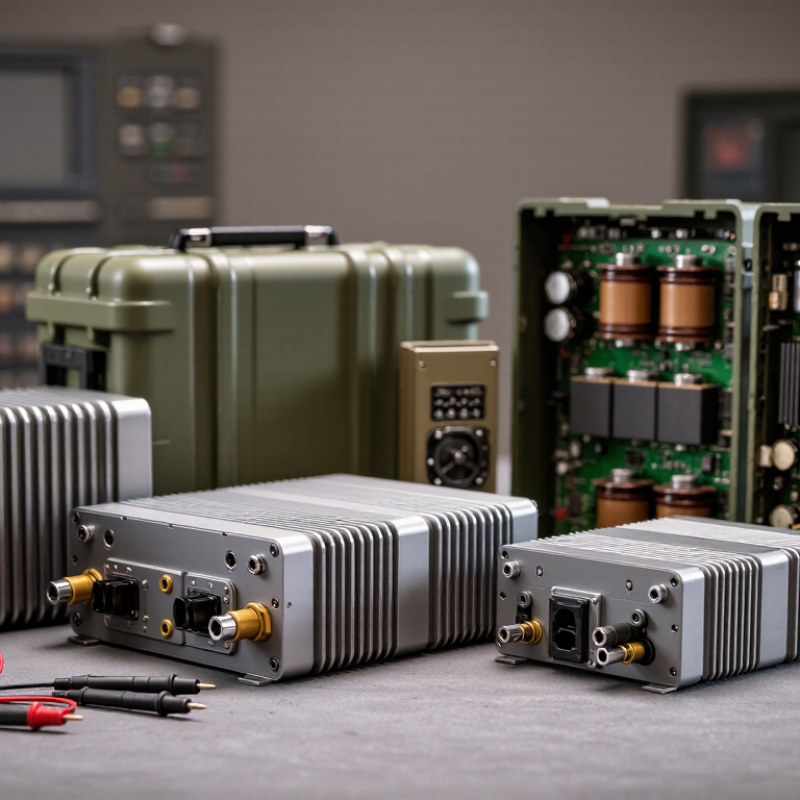
A COTS AC-DC converter is a commercially available power unit that changes alternating current into regulated direct current. In military systems, it feeds radios, displays, sensors, embedded computers, and mission-control electronics. Unlike a custom supply, a COTS unit uses established manufacturing processes and standard qualification evidence. This can shorten procurement cycles and reduce redesign costs.
The converter must tolerate vibration, shock, humidity, temperature changes, and unstable input power. Engineers commonly review requirements linked to MIL-STD-810 and MIL-STD-704, alongside safety, electromagnetic compatibility, and thermal data. Efficiency matters inside a sealed vehicle enclosure. A small loss can become significant heat during continuous operation. It is not merely a plug-in component.
Demand is also shaped by wider defense investment. The U.S. Department of Defense requested about 849.8 billion dollars for fiscal year 2025, according to its FY2025 Budget Request. SIPRI’s Trends in International Arms Transfers 2024 reported an 8% increase in European arms imports during 2020–2024. These figures indicate sustained modernization pressure, but they do not guarantee converter suitability. That distinction matters.
In field reviews, documentation often reveals more than headline efficiency. Buyers should examine derating curves, hold-up time, conducted emissions, repairability, and component traceability. COTS does not mean untested. It means commercially developed.
The weak point is integration. A converter may pass laboratory tests yet behave poorly beside sensitive receivers. Engineers should validate the complete power chain, not only the converter. Some assumptions will fail. That is why independent testing remains essential.
2026 Top Mil COTS AC DC Converters for Global Buyers
Key Performance Standards for Military-Grade Power Conversion
Military-grade AC/DC conversion begins with verified performance, not a rugged-looking enclosure. Buyers should review input range, output regulation, ripple, efficiency, isolation, and hold-up time. A 50°C ambient test often reveals weaknesses hidden by room-temperature specifications. Derating matters.
For aircraft and vehicle systems, compatibility with MIL-STD-704 may be essential. EMI performance should be assessed against MIL-STD-461 requirements, while vibration, shock, humidity, and temperature testing may reference MIL-STD-810. These standards address different risks. One certificate cannot prove total suitability.
Global buyers should request complete test reports, revision levels, safety approvals, and production traceability. Check whether testing covers the exact model, input range, and mounting position. A converter rated for 85–264 VAC may still require external filtering in a noisy installation. That detail is easy to miss.
Thermal design deserves close attention. Measure case temperature near transformers, switching devices, and terminal blocks. A compact converter may save cabinet space but lose efficiency under continuous load. Real systems rarely operate at ideal loads. Engineers should also confirm creepage, clearance, surge immunity, and protection against short circuits or overloads.
Some specifications remain incomplete. Datasheets may omit transient recovery time or acoustic behavior. That creates uncertainty. Independent validation is wiser than relying on marketing language. A practical evaluation should include cold starts, repeated power cycling, peak-load changes, and operation near the stated limits. The final choice should reflect the complete system, not the converter alone.
For global buyers, COTS AC-DC converter categories now reflect different installation realities. Open-frame units suit compact appliances and control cabinets with protected interiors. Enclosed converters offer safer mounting in dusty industrial spaces. DIN-rail models simplify factory upgrades, especially where 24 VDC control systems are standard. External desktop adapters remain practical for instruments and small equipment.
Medical-grade converters require reinforced isolation, low leakage current, and documented test evidence. Modular AC-DC systems support higher power and easier servicing, but their added complexity can increase procurement risk. Grand View Research estimates the global AC-DC power supply market could expand at about 6% annually through 2030. MarketsandMarkets reports a faster growth outlook for the broader power supply market, approaching 9% CAGR through 2028. The figures differ because market definitions differ.
Check the details.
A reliable 2026 evaluation should compare input range, efficiency, standby power, thermal derating, certifications, and lifecycle support. Buyers operating across regions should confirm 100–240 VAC compatibility and local plug requirements. IEC 62368-1 remains central for many ICT and industrial products, while medical applications need stricter evaluation. Datasheets may show excellent efficiency at full load, yet field equipment often runs below 50%. That gap deserves testing. Even experienced teams sometimes underestimate humidity, vibration, and replacement lead times. A small converter can create a large redesign.
For global buyers, efficiency is more than a catalog percentage. The IEA’s Electricity 2024 report estimates data-center demand could exceed 1,000 TWh by 2026. Even small conversion losses matter. Compare efficiency at 10%, 50%, and full load, not only at the headline rating. U.S. Department of Energy Level VI requirements also address active efficiency and no-load power. A converter drawing 0.1 watts in standby may outperform a larger unit with poor light-load behavior.
Reliability requires evidence from real operating conditions. Check MTBF, but do not treat it as a guarantee. MTBF is often calculated, not observed. Ask for temperature derating curves, capacitor life estimates, burn-in procedures, and failure-rate data. A unit rated for 50°C may need derating above that point. Safety and integration deserve equal attention. Verify IEC 62368-1 compliance, insulation ratings, leakage current, EMC test results, and protective functions. Confirm input ranges such as 90–264 VAC and 47–63 Hz. Mechanical clearance matters too. A converter that fits electrically may still block airflow or complicate service access.
Tips: Build a weighted scorecard. Give efficiency, reliability, safety, and integration separate scores. Test one sample under peak load, low line voltage, and high ambient heat. Document surprises. The first test may expose them. Select certified units with traceable reports, clear tolerances, and stable documentation. Some specifications remain vague, and that should count against the supplier.
Selecting the best 2026 MIL COTS AC DC converter requires more than comparing output power and price. International buyers should verify input ranges, frequency tolerance, startup behavior, hold-up time, and load derating. A converter rated for 85–264 VAC may still perform poorly during brownouts or generator transitions. Check operating temperature, altitude, vibration, shock, humidity, and cooling requirements against the actual deployment site. MIL-STD-810 testing supports environmental confidence, but laboratory compliance does not guarantee field reliability.
Efficiency also affects procurement decisions. The IEA’s Electricity 2024 report estimates that data centers consumed about 460 TWh globally in 2022, with demand potentially exceeding 1,000 TWh by 2026. Even small conversion losses become expensive in continuous systems. Review efficiency curves at 20%, 50%, and 100% load, not only the headline peak. Confirm conducted and radiated emissions against applicable MIL-STD-461 and IEC requirements. Safety evaluation under IEC 62368-1 may simplify civilian deployments, but regional documentation still matters.
Supply resilience deserves equal attention. Request lifecycle statements, change-control policies, traceability records, and realistic lead-time data. A low-cost unit is not economical if qualification must restart after an undocumented component change. Field experience suggests that connector retention and thermal margins are often underestimated. They should not be. I would also compare repair options, customs documentation, spare-unit ratios, and local technical support before approving a global purchase. A perfect datasheet cannot replace deployment evidence.
Check input range, frequency tolerance, output regulation, ripple, efficiency, isolation, and hold-up time. Derating matters. Review performance at 50°C, not only room temperature.
No. A unit rated for 85–264 VAC may struggle during brownouts or generator transitions. Test startup, recovery, and repeated power cycles. External filtering may be necessary in noisy cabinets.
Match temperature, altitude, vibration, shock, and humidity ratings to the installation site. A vehicle roof and a cooled equipment room create different stresses. Laboratory compliance is useful, but field reliability remains uncertain.
Measure temperatures near transformers, switching devices, and terminal blocks. Test continuous operation at realistic loads. Small enclosures can save space but lose efficiency under heat.
Aircraft and vehicle systems may require compatibility with MIL-STD-704. EMI testing may reference MIL-STD-461. Environmental testing may reference MIL-STD-810. One certificate proves only one area.
Request complete test reports, revision levels, safety approvals, traceability records, and lifecycle statements. Confirm testing covers the exact model and mounting position. Missing paperwork can delay qualification.
Compare efficiency at 20%, 50%, and 100% load. Peak efficiency alone can mislead. A small conversion loss becomes significant across thousands of operating hours.
Review lead times, change-control policies, spare-unit ratios, repair options, and customs documents. Connector retention is often underestimated. I would also question any undocumented component change.
Mil-COTS AC-DC Converters are commercially available power conversion solutions adapted for demanding military and defense-related systems, offering a practical balance between performance, availability, and cost. In 2026, global buyers can evaluate categories such as enclosed, modular, ruggedized, and board-level AC-DC converters according to application requirements. Key considerations include input voltage range, regulated output, power density, thermal management, electromagnetic compatibility, shock and vibration resistance, and operation across harsh environmental conditions. Compliance with relevant military and international safety standards is also essential for dependable deployment.
When comparing products, buyers should assess conversion efficiency, expected service life, fault protection, maintainability, integration flexibility, and verified reliability under continuous operation. International procurement also requires careful review of certifications, documentation, supply continuity, regional electrical requirements, customs considerations, technical support, and lifecycle costs. A structured evaluation process helps organizations select Mil-COTS AC-DC Converters that deliver secure, efficient, and scalable power performance while supporting responsible deployment across diverse global operating environments.