In 2026, selecting a Military Field-Grade 3-Phase UPS requires more than comparing power ratings. A unit may operate beside a mobile command shelter, endure dust, vibration, and unstable generators, then protect sensitive electronics without interruption. The enclosure, cooling path, battery system, transfer performance, and maintenance design all matter.
Eaton power-quality specialist Ed Spears has emphasized, “Power protection is only effective when it matches the equipment and operating environment.” That principle shapes this buying guide. A 3-phase UPS should match the real load, not an optimistic spreadsheet. Check continuous demand, startup surges, power factor, overload duration, and future expansion. Small errors become expensive in the field.
Ruggedness matters.
Look for sealed connections, shock-resistant construction, wide temperature tolerance, and clear status indicators visible through poor lighting. Lithium-ion batteries may reduce weight, but thermal monitoring and service procedures deserve close attention. Lead-acid systems can remain practical where logistics and replacement habits favor them. Neither choice is automatically superior.
This guide also examines online double-conversion topology, generator compatibility, electromagnetic resilience, bypass operation, remote monitoring, and repair access. Certification evidence should come from traceable test reports, not vague marketing claims. Vendors should explain warranty limits, battery life assumptions, spare-part availability, and technician training.
No checklist is flawless. A lighter UPS may simplify transport but reduce runtime. A larger model may offer comfort while consuming valuable shelter space. That trade-off deserves honest review. The strongest purchase decision connects engineering data with field experience, documented testing, and the people who will maintain the system under pressure.
Military Field-Grade Three-Phase UPS: Definition and Core Functions
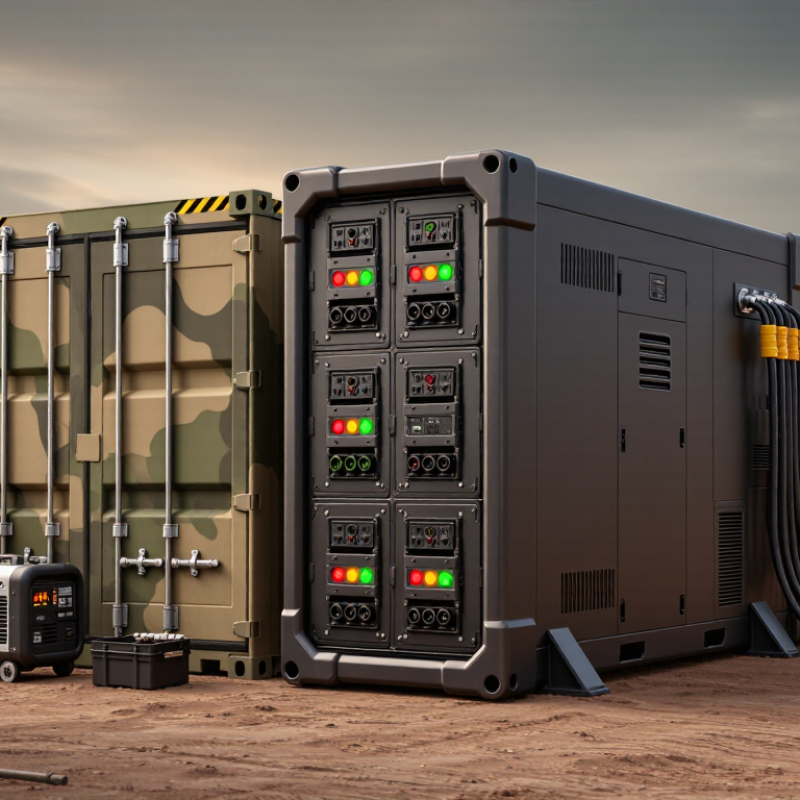
A military field-grade three-phase UPS protects mission equipment from unstable or interrupted power. It combines a rectifier, battery system, inverter, and automatic bypass. The rectifier converts incoming AC power into controlled DC power. The inverter then supplies clean three-phase AC power to connected loads. This process limits voltage changes, frequency shifts, and electrical noise.
These UPS systems support radar shelters, mobile command units, medical stations, and communications equipment. A rugged enclosure helps resist dust, moisture, vibration, and temperature changes. Batteries provide temporary power during an outage. Runtime depends on load size, battery condition, and operating temperature. It is never wise to trust the nameplate runtime alone.
The bypass circuit keeps equipment energized during maintenance or internal faults. Monitoring functions can display input voltage, output current, battery health, alarms, and remaining runtime. Remote communication also helps operators identify problems before an outage becomes serious. During a site inspection, technicians should check cable connections, ventilation paths, grounding, and battery swelling. Small defects matter.
Protection should match the actual mission profile. A unit designed for a climate-controlled shelter may perform poorly in a dusty vehicle bay. Engineers should verify phase balance, overload capacity, transfer behavior, and service access. No UPS design is perfect. Poor maintenance can defeat excellent hardware. Testing under realistic loads often reveals weaknesses that routine screen checks miss.
Technical comparison of common procurement specifications and core functions
| Evaluation Dimension | Typical Field-Grade Requirement | Why It Matters in 2026 |
|---|---|---|
| UPS Definition | A ruggedized uninterruptible power system that conditions incoming power and supplies continuous three-phase AC power to mission-critical loads. | Supports communications, command systems, sensors, mobile shelters, medical equipment, and edge-computing loads where power interruption is unacceptable. |
| UPS Topology | Online double-conversion topology with static bypass and maintenance-bypass provisions. | Provides continuous voltage and frequency regulation and avoids transfer interruption during normal operation. |
| Phase Configuration | Three-phase input and three-phase output; some systems support configurable input/output arrangements for deployment flexibility. | Matches industrial, shelter-based, generator-backed, and large distributed loads more efficiently than single-phase systems. |
| Typical Power Range | Approximately 10–200 kVA for many mobile or deployable applications; larger fixed installations may exceed this range. | Allows sizing from compact command shelters to larger field operations without specifying a particular manufacturer. |
| Nominal Output Voltage | Common configurations include 208Y/120 V, 400Y/230 V, and 480Y/277 V at 50 or 60 Hz, subject to the site power system. | Correct voltage selection prevents transformer losses, overloads, and incompatibility with deployed equipment. |
| Output Regulation | Typically maintained within approximately ±1% under balanced operating conditions, depending on the selected design. | Reduces power-quality stress on sensitive electronics and improves system stability during generator operation. |
| Frequency Regulation | Typically 50/60 Hz selectable or frequency-converting, with regulated output independent of moderate input-frequency variation. | Improves compatibility with tactical generators and unstable utility sources. |
| Transfer Time | Zero transfer time in online double-conversion mode; bypass transfer time depends on the static-switch design and synchronization conditions. | Maintains continuity for servers, radios, control electronics, and other loads that cannot tolerate a conventional transfer delay. |
| Battery Technology | Valve-regulated lead-acid, lithium-ion, or other approved battery systems; external battery cabinets are often used for extended runtime. | Battery choice affects weight, transportability, thermal management, service life, safety controls, and total ownership cost. |
| Battery Runtime | Common design targets range from 5–15 minutes at rated load, with longer autonomy available through external battery strings or generator coordination. | Runtime should bridge generator start-up, source transfer, orderly shutdown, or tactical relocation requirements. |
| Generator Compatibility | High input power factor, low input current distortion, adjustable rectifier controls, and generator-sizing guidance are preferred. | Minimizes generator oversizing, frequency hunting, voltage distortion, and nuisance transfer events. |
| Overload Capability | Short-duration overload support and electronic current limiting; exact capacity and duration must be verified in the technical datasheet. | Helps accommodate inrush currents from motors, transformers, power supplies, and communications equipment. |
| Environmental Operating Range | Ruggedized designs may be specified for approximately −20°C to +55°C, with derating often required at elevated temperatures. | Temperature, humidity, dust, salt exposure, and altitude can materially reduce battery life and power-conversion capacity. |
| Ingress and Ruggedization | Specify the required enclosure rating, shock and vibration performance, corrosion protection, dust filtration, and transport restraints for the mission. | A standard indoor UPS enclosure may not withstand vehicle transport, exposed field conditions, or temporary shelter deployment. |
| EMI and EMC Control | Input and output filtering, shielding, grounding, and verification against the applicable military or industrial EMC requirements. | Limits conducted and radiated interference that could affect radios, sensors, navigation systems, and secure electronics. |
| Monitoring and Communications | Local display plus dry contacts, Modbus, SNMP, or other network interfaces for alarms, battery status, load level, bypass state, and event logs. | Enables remote supervision and faster fault response when the UPS is deployed in an unmanned or distributed location. |
| Efficiency | Double-conversion efficiency commonly falls in the mid-90% range; economy modes can be higher but may reduce conditioning performance. | Efficiency affects fuel consumption, heat rejection, cooling requirements, and mission endurance. |
| Standards and Verification | Evaluate applicable IEC 62040 requirements, electrical safety rules, EMC requirements, environmental test methods, and contract-specific military standards. | Compliance must be matched to the operating country, platform, installation method, and procurement contract rather than assumed from a product label. |
| Maintainability | Front-access service, modular power assemblies, replaceable fans, battery monitoring, bypass isolation, field-replaceable components, and documented maintenance procedures. | Shortens downtime and reduces the need for specialized tools or factory-level repair in remote operating areas. |
It protects critical equipment from unstable or interrupted electricity. It uses a rectifier, batteries, inverter, and automatic bypass. The inverter supplies clean three-phase power. Simple in design, demanding in operation.
They can support mobile command units, radar shelters, medical stations, and communication equipment. Rugged enclosures resist dust, moisture, vibration, and temperature changes. A climate-controlled model may fail in a dusty vehicle bay.
Runtime depends on load size, battery condition, and temperature. A display showing 30 minutes may assume ideal conditions. Test the battery at 25%, 50%, and 75% loads. Do not trust the nameplate alone.
Record watts, VA, power factor, and motor starting currents. Check input voltage, output voltage, frequency, phase balance, and overload capacity. Leave about 20% spare capacity for growth and derating. Measure twice.
Uneven phase demand can waste capacity and heat cables. Confirm the neutral requirements and balance limits. Radio transmissions and cooling cycles may change the load suddenly. That detail is easy to miss.
Testing should cover vibration, shock, dust, humidity, altitude, and temperature cycling. Electrical interference testing also matters near radios and sensors. Sealing alone proves little. Test the complete installation.
The bypass keeps connected equipment energized during maintenance or certain internal faults. Technicians should verify transfer behavior under realistic loads. A bypass is helpful, but it does not solve every failure.
Inspect cable connections, ventilation paths, grounding, alarms, and battery swelling. Review recharge time and remaining-runtime accuracy. Check connectors and seals after repeated handling. Small defects matter. We sometimes notice them too late.
Monitoring can show input voltage, output current, battery health, alarms, and remaining runtime. Remote communication may reveal problems before an outage. Network connections also need cybersecurity review. Remote visibility is not perfect.
This 2026 buying guide explains how a Military Field-Grade 3-Phase UPS supports reliable power for tactical, mobile, and mission-critical environments. It covers the system’s core functions, including power conditioning, voltage regulation, seamless backup, battery management, and protection for sensitive electronic equipment. Readers will also learn how to assess power capacity, battery runtime, load priorities, phase configuration, scalability, and compatibility with field generators or temporary power systems.
The guide highlights key evaluation areas such as rugged construction, shock and vibration resistance, dust and moisture protection, wide operating temperatures, electromagnetic resilience, transportability, and serviceability. It also outlines practical selection criteria for deployable three-phase UPS equipment, helping users balance output performance, runtime, size, weight, safety, monitoring capabilities, maintainability, and lifecycle cost. The goal is to support informed procurement decisions without compromising operational reliability in demanding environments.